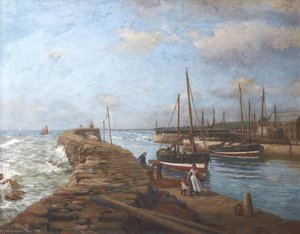
John Mcghie: Painter of Fife’s Coastal Soul
John Mcghie (1867 – 1952) remains a largely unsung figure in Scottish art history, yet his evocative depictions of the Fife coastline and its maritime traditions hold a unique place within the broader landscape of Victorian and Edwardian painting. Born in Cupar Muir, Angus, Mcghie’s artistic journey began modestly but blossomed into a prolific career dedicated to capturing the essence of his surroundings – specifically the rugged beauty of St Andrew's Bay and the bustling harbor life of Craigsmuir.
Early Life & Artistic Beginnings
Little is known about Mcghie’s formative years beyond confirmation that he was educated at St Mary’s Cathedral School in Dundee, where he honed his artistic skills under the tutelage of William Angus McLaren. McLaren instilled in Mcghie a deep appreciation for landscape painting and encouraged him to explore tonal harmonies—a technique championed by artists like Albert Pinkham Ryder and Frederic Church—which would become hallmarks of Mcghie's distinctive style. This early influence undoubtedly shaped Mcghie’s artistic sensibilities, prioritizing atmospheric perspective and subtle color palettes.
The Influence of Ryder & Church: Embracing Atmospheric Perspective
Mcghie’s artistic vision was profoundly impacted by the American Transcendentalist painters Albert Pinkham Ryder and Frederic Church, whose explorations of light and color in landscapes captivated Mcghie's imagination. Like Ryder and Church, Mcghie skillfully employed atmospheric perspective—the gradual diminution of detail and color with increasing distance—to convey a sense of depth and grandeur within his canvases. This technique allowed him to transform ordinary coastal scenes into immersive experiences for the viewer, mirroring the spiritual contemplation championed by these influential figures.
Style & Technique: Capturing Fife’s Maritime Spirit
Mcghie's artistic style is characterized by meticulous observation combined with a masterful command of tonal harmonies and color palettes. He favored oil paints on canvas, applying them in thin layers to build up texture and luminosity—a technique that allowed him to capture the shifting moods of the Fife coast. His paintings frequently depict harbor scenes teeming with fishing boats and figures engaged in daily life, portraying not merely visual representations but also conveying a palpable sense of place and community. Recurring motifs included depictions of St Andrew’s Bay, Craigsmuir Harbor, and portraits of local fishermen—subjects that reflected Mcghie's deep connection to his surroundings.
Notable Works & Recognition
Mcghie produced over 300 paintings throughout his lifetime, many of which are housed in private collections and galleries across Scotland. Among his most celebrated works include “St Andrew’s Bay at Dusk,” a breathtaking depiction of the bay bathed in twilight hues—a masterpiece that exemplifies Mcghie's ability to capture the sublime beauty of nature. Similarly, "Craigsmuir Harbor" portrays the vibrant activity of the harbor with remarkable detail and sensitivity, capturing the energy and spirit of Fife’s fishing community. Although Mcghie received limited formal recognition during his lifetime, his paintings continue to resonate with collectors and art historians alike who appreciate their understated elegance and profound connection to Scottish landscape tradition.
Legacy & Historical Significance
John Mcghie's contribution to Scottish painting deserves renewed attention. His unwavering dedication to capturing the spirit of Fife’s coastal environment—particularly its maritime traditions—established him as a significant voice within Victorian and Edwardian art. Unlike many artists of his era who sought grand narratives or heroic subjects, Mcghie focused on portraying everyday life with remarkable accuracy and empathy. By prioritizing tonal harmonies and atmospheric perspective—techniques championed by Ryder and Church—Mcghie elevated landscape painting to a realm of contemplative beauty, leaving behind a legacy that continues to inspire admiration for its quiet grandeur and enduring relevance. His work serves as a testament to the power of observation and artistic sensitivity in conveying the essence of place and time.