A Life Immersed in Art and Music
Georges Valmier, born in Angoulême, France, on April 11th, 1885, was an artist whose life became deeply interwoven with the burgeoning artistic movements of the early 20th century. His formative years were profoundly shaped by a relocation to Montmartre in 1890, a district already pulsating with creative energy. This immersion fostered not only a passion for painting but also a deep love for music – two disciplines that would remain inextricably linked throughout his career. After completing military service from 1904-1905, a pivotal moment arrived in 1907 when Valmier encountered the groundbreaking work of Paul Cézanne at the Salon d’Automne. This encounter proved transformative, setting him on a path that would lead him through Impressionism, Cubism, and ultimately towards abstraction. Formal training followed at the École des Beaux-Arts from 1907 to 1909 under Luc-Olivier Merson, though Valmier would later find its rigid structure somewhat stifling. His personal life also blossomed during this period; he married Jeanne Bliss Pessina in 1908 and welcomed his daughter, Martha, into the world in 1912.
From Cubist Geometry to Abstract Visions
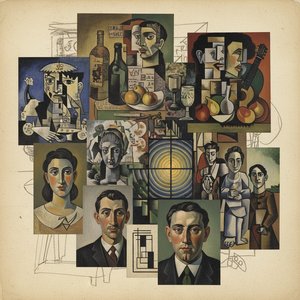
Valmier’s artistic journey was one of constant evolution, mirroring the radical shifts occurring within the art world itself. His early works reveal the influence of Impressionism, but around the age of twenty-five, he wholeheartedly embraced Cubism. This period saw him dissecting forms and emphasizing geometric shapes in self-portraits, portraits, still lifes, and evocative landscapes of Montmartre. However, Valmier wasn’t merely replicating the style; he infused it with a unique sensibility, exploring color and composition in ways that distinguished his work from his contemporaries. From 1921 onwards, a significant transformation took place as Valmier transitioned towards Abstractionism. This new direction was characterized by a loosening of structure, an embrace of vibrant colors, and the dynamic interplay of overlapping planes. He wasn’t simply abandoning representation; rather, he sought to express inner emotions and spiritual concepts through pure form and color. His commitment to this path led him to become an early member of the board of *Abstraction-Création* in 1932, alongside luminaries such as Jean Arp, Albert Gleizes, and František Kupka – a testament to his standing within the avant-garde movement.
Relationships and Recognition
Valmier’s career benefited from key relationships that nurtured his talent and provided crucial opportunities. His time serving in Toul during World War I (1914-1918) brought him into contact with Albert Gleizes and Florent Schmitt, fostering both collaboration and artistic exchange. An anecdote highlighting Valmier's skill even within a more traditional style recounts Dr. Lambert’s preference for his portrait over that of Gleizes. However, the most significant relationship was undoubtedly the one he forged with Léonce Rosenberg after World War I. Recognizing Valmier’s exceptional talent, Rosenberg took him under contract in 1919 and provided invaluable support. This partnership culminated in a solo exhibition at Rosenberg's Galerie de l’Effort Moderne in 1921, offering Valmier significant exposure to the Parisian art scene. His work was regularly featured in Rosenberg’s *Bulletin de l'Effort Moderne* from 1923 to 1927, further solidifying his reputation. Rosenberg also commissioned Valmier to decorate the dining room of his apartment on rue de Longchamp – a project that showcased Valmier’s versatility and secured his place within Rosenberg’s esteemed art collection.
A Synthesis of Disciplines and Lasting Legacy
Beyond painting, Georges Valmier was a gifted musician, performing works by Debussy, Ravel, Fauré, and Satie in major concerts and churches. This musical talent wasn't merely a separate pursuit; it profoundly influenced his artistic vision, informing his sense of rhythm, harmony, and composition. Indeed, his musical sensibility had a significant impact on the career of André Jolivet. In 1936, despite battling ill-health since 1932, Valmier embarked on an ambitious project: creating three monumental works for the decoration of the theater within the Palace of Railways for the Paris World Expo in 1937. Sadly, he would not live to see their completion, passing away prematurely at the age of fifty-one on March 25th, 1937. Despite his relatively limited output – around 300 oil paintings – each piece is imbued with a unique energy and artistic depth. His preparatory gouaches are themselves considered works of art, revealing his meticulous approach to color and form. Valmier’s legacy lies in his ability to synthesize Cubist principles with an evolving move towards abstraction, making a significant contribution to the development of abstract art in France. Today, his paintings can be found in prominent museums worldwide, including The Solomon R. Guggenheim Museum (New York), Kröller-Müller Museum (Otterlo), and Musées des Beaux-Arts de Nancy, ensuring that his innovative vision continues to inspire generations of artists and art lovers alike.