The Soul of the Russian Landscape: The Art of Fedor Stepanovitch
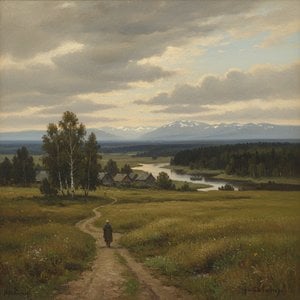
Born in 1948 in the historic city of Krasnodar, Russia, Fedor Stepanovitch Zhegusov emerged from a rich cultural lineage to become a profound voice in contemporary Russian painting. His journey into the world of fine art began in his youth, driven by an innate talent that allowed him to perceive the subtle rhythms of the natural world and the weight of historical memory. Through his brush, the quietude of the countryside and the monumental gravity of the past are woven together into a singular, evocative tapestry. His work does not merely depict scenes; it captures the very breath of the Russian landscape and the enduring spirit of its people.
The essence of Stepanovitch’s artistry lies in his ability to balance realism with a deep-seated romanticism. This duality allows him to create compositions that are both grounded in the tangible details of rural life and elevated by an emotional resonance that transcends time. His technique is heavily influenced by the venerable traditions of the Russian school, drawing inspiration from the masters who preceded him to create works that feel both timeless and deeply personal. In his hands, a simple pastoral scene becomes a meditation on the harmony between humanity and the earth.
A Tribute to History and Labor
One of the most poignant expressions of Stepanovitch’s vision can be found in his masterpiece, Peaceful Work: The Mower. This work serves as the central pillar of a profound triptych dedicated to the soldiers of the Great Patriotic War. In this piece, the artist masterfully captures the serene beauty of agricultural labor, yet beneath the surface lies a complex layer of historical significance. By juxtaposing the peaceful rhythm of the mower with the memory of wartime sacrifice, he honors the resilience of those who maintained the heartbeat of the nation during its darkest hours.
This thematic focus on the Great Patriotic War demonstrates Stepanovitch’s deep commitment to preserving Russian cultural and historical identity. His paintings act as a bridge between generations, ensuring that the labor, the struggle, and the quiet dignity of the past are never forgotten. The way he portrays the connection between the worker and the land serves as a powerful metaphor for the endurance of life amidst the shadows of conflict.
Legacy and Artistic Recognition
The enduring impact of Fedor Stepanovitch’s work is reflected in its presence within esteemed cultural institutions. His paintings serve as vital links to the Russian and Ukrainian artistic heritage, finding homes in galleries that celebrate the depth of Eastern European mastery. Notable collections that house his evocative works include:
- The Kharkov Museum of Art (Ukraine): A significant repository where his contributions to the broader narrative of Russian and Ukrainian art can be studied and admired.
- The Astrakhan State Picture Gallery: An institution that showcases his ability to blend monumental themes with delicate, lifelike execution.
Through his dedication to capturing the essence of rural life and his reverence for historical truth, Fedor Stepanovitch has left an indelible mark on the art world. His oeuvre remains a testament to the power of painting to serve as both a mirror to nature and a monument to the human spirit.