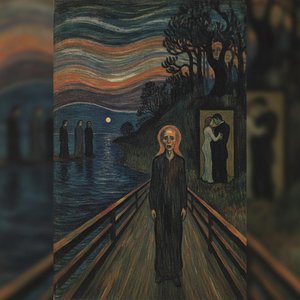
A Chronicle of Urban Souls: The World of Claudio Ethos
Claudio Rafael, known globally as Claudio Ethos, is a Brazilian muralist whose work transcends the boundaries of street art, delving into the complex realms of human emotion and spiritual experience. Born in São Paulo in 1982, Ethos emerged from a city steeped in vibrant graffiti culture—specifically the distinctive “Pichação” style—but quickly forged his own path, one defined by large-scale surreal imagery and a hauntingly minimal color palette. His art isn’t merely *about* urban life; it is an extension of it, breathing with its anxieties, struggles, and quiet moments of resilience.
Ethos's artistic journey began in the 1990s, immersed in the dynamic energy of São Paulo’s tagging scene. While many peers embraced bold colors and intricate lettering, Ethos gravitated towards a more introspective approach. After two years studying visual arts at college, he consciously chose to abandon formal education, believing that true artistic growth lay in direct engagement with the world—in traveling, observing, and relentlessly honing his skills through practice. This decision proved pivotal; it allowed him to cultivate a unique voice unburdened by conventional constraints.
The Language of Struggle: Technique and Symbolism
What immediately distinguishes Ethos’s work is its striking visual language. He primarily employs ballpoint pen as his medium, an unconventional choice for monumental murals that speaks volumes about his dedication to detail and control. The meticulous linework creates a sense of fragility juxtaposed with the sheer scale of the pieces—a powerful metaphor for the human condition within the overwhelming urban landscape. His color palette is deliberately restrained, often limited to black, white, and a single accent hue, intensifying the emotional impact and lending an almost dreamlike quality to his compositions.
The figures that populate Ethos’s murals are rarely portraits of specific individuals; rather, they represent archetypal states of being. They are anxious, struggling forms caught in moments of contemplation or despair, often depicted within claustrophobic urban settings. These characters aren't simply *in* the city—they *are* the city, embodying its pressures and contradictions. Ethos himself describes his intention as an attempt to “depict emotional and spiritual states because there are no accurate definitions for so many of these sensations.” This pursuit of intangible feelings is central to understanding his art; he isn’t interested in literal representation but in evoking a visceral response from the viewer, prompting introspection and empathy.
From São Paulo to the Global Stage: Recognition and Impact
Ethos's work quickly garnered attention within Brazil, and soon began to transcend national borders. His murals can now be found across the globe—from Munich and San Francisco to New York, Colombia, and Turkey—transforming public spaces into poignant reflections on the human experience. He has exhibited in numerous museums and galleries throughout Europe and beyond, solidifying his position as a leading figure in contemporary urban art.
A significant milestone was his inclusion in the opening of URBAN NATION Museum in Berlin in 2017, showcasing his work alongside other prominent street artists. This recognition not only broadened his audience but also validated the artistic merit of muralism as a legitimate form of expression. His participation in events like the Artmossphere Biennale in Moscow further cemented his international reputation.
A Legacy of Intuition: Influences and Historical Significance
While acknowledging the influence of Brazilian street art pioneers such as Os Gemeos, Vitche, Onesto, and Herbert Baglione, Ethos has undeniably carved out a unique artistic identity. His work stands apart through its singular technique, haunting symbolism, and unwavering focus on emotional depth.
Ethos’s historical significance lies in his ability to connect the viewer with the often-overlooked realities of urban life—the anxieties, struggles, and spiritual yearnings that permeate modern existence. He doesn't offer easy answers or grand narratives; instead, he presents a raw, honest portrayal of the human condition, inviting us to confront our own emotions and find meaning within the chaos. His art is a testament to the power of intuition, reminding us that some sensations are best expressed not through definition but through feeling—a legacy etched onto walls around the world.