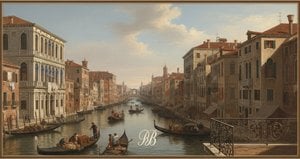
Bernardo Ferrari (1598-1669) stands as a pivotal figure in the vibrant artistic landscape of 17th-century Genoa, a city renowned for its distinctive brand of Baroque painting. Born into a family of means in Genoa, he initially pursued studies in literature before recognizing his true calling lay within the realm of art. His journey began under the tutelage of Bernardo Castello and later, the influential Bernardo Strozzi, absorbing techniques and stylistic nuances that would shape his unique artistic voice. Ferrari’s training wasn't merely academic; it was deeply influenced by the works of Anthony van Dyck, a Flemish master whose elegant portraits and dynamic compositions resonated profoundly with the young Italian artist. This confluence of influences—the rigorous foundations of Genoese tradition combined with the refined sensibilities of the Flemings—resulted in an artistic style characterized by a captivating blend of technical skill and expressive emotion.
Early Life, Training, and Artistic Style
Ferrari’s early life provided him with the stability to dedicate himself fully to his art. He wasn't constrained by financial worries, allowing him to immerse himself in his studies and develop a distinctive approach. His artistic style is immediately recognizable through several key elements. Firstly, he favored a thinner application of paint, creating surfaces that appear luminous and almost translucent—a departure from the heavier, more opaque styles prevalent at the time. Secondly, his portraits are distinguished by expressive heads, often imbued with a subtle psychological depth, and tapered hands rendered with remarkable delicacy. The drapery in his paintings is frequently rolled tightly, adding to the sense of movement and dynamism. Ferrari’s religious subjects—a common theme within the Baroque period—are particularly noteworthy for their lyrical quality and emotional intensity. He skillfully employed light and shadow to heighten drama and convey a profound sense of spirituality.
Collaborations, Pupils, and Artistic Circles
Ferrari's artistic career unfolded within a thriving network of artists in Genoa. He collaborated extensively with Giovanni Andrea Ansaldo on several projects, demonstrating the interconnectedness of the Genoese art scene. Furthermore, he served as a mentor to numerous pupils, including Giovanni Bernardo Carbone, Sebastiano Cervetto, and Giovanni Andrea Podestà, ensuring the continuation of his artistic legacy. These apprentices absorbed not only Ferrari’s technical skills but also his distinctive stylistic sensibilities. The influence of these collaborations and mentorships highlights Ferrari's role as a key figure in shaping the development of Baroque art within Genoa. His connections extended beyond direct instruction; he was part of a broader artistic community, engaging with fellow artists and sharing ideas and techniques.
Key Works and Influences
Ferrari’s most celebrated works often depict religious scenes, frequently featuring depictions of the Madonna and Child, alongside saints and biblical figures. His painting *Portrait of Emilio Omodeo* (1643), now housed in the L'Archimede Gallery of Art in Rome, exemplifies his mastery of portraiture, capturing the subject’s personality with remarkable subtlety and grace. The influence of Anthony van Dyck is particularly evident in the elegant poses, refined attire, and carefully rendered details of these portraits. Beyond portraiture, Ferrari also produced altarpieces and devotional panels that showcase his ability to evoke a sense of piety and reverence. His work reflects not only the prevailing artistic trends of the Baroque period but also the unique cultural context of Genoa—a city steeped in maritime history and religious fervor.
Legacy and Historical Significance
Bernardo Ferrari’s legacy extends far beyond his individual works. He played a crucial role in establishing a distinct Genoese style within the broader framework of Baroque art. His influence can be seen in the subsequent work of many artists, solidifying his position as one of the most important figures in the city's artistic history. Recent efforts to restore a significant altarpiece depicting Saint Francis presenting the patron saints Ludovic IX King of France and Elizabeth Queen of Portugal, housed in the church of San Nicolosio in Genoa, underscore the enduring value of his art. This project, supported by the community, demonstrates that Ferrari’s work continues to resonate with audiences today, reminding us of the power and beauty of Baroque painting. His paintings are studied by art historians and enthusiasts alike, ensuring that his contributions to the artistic world will be remembered for generations to come.
Από την επιβλεπόμενη ομάδα της WahooArt.com
Δοκιμάστε το μάτι σας
Για κάθε ερώτηση υπάρχει μόνο μία σωστή απάντηση.
Ερώτηση 1:
Bernardo Ferrari was primarily active during which artistic period?
Ερώτηση 2:
Which of the following best describes Bernardo Ferrari's artistic style?
Ερώτηση 3:
Bernardo Ferrari's early training involved studying which subject before dedicating himself to art?
Ερώτηση 4:
Who significantly influenced Bernardo Ferrari’s artistic style, particularly in his use of portraiture?
Ερώτηση 5:
Bernardo Ferrari collaborated with which artist on several projects?
Explore the life & art of Bernardo Bellotto, Canaletto’s nephew and a master of veduta painting. Discover his stunning cityscapes of Dresden & Warsaw, artistic techniques, and lasting legacy. Expert insights for collectors.
Ποια χρώματα χρησιμοποίησε πιο συχνά ο/η Bernardo Ferrari;
Η Γενετικό Σύστατο Παλέτας του Bernardo Ferrari παρουσιάζει το χρωματικό προφίλ του συνολικού έργου του καλλιτέχνη.
Πού μπορώ να επισκεφτώ μια 3D γκαλερί με τα έργα του/της Bernardo Ferrari;
Τα έργα τέχνης του/της Bernardo Ferrari μπορούν να περιηγηθούν σε μια 3D γκαλερί στη σελίδα 3D Μουσείο του καλλιτέχνη/της.
Πού ομαδοποιούνται τα έργα του Bernardo Ferrari με βάση λέξεις-κλειδιά;
Ανακαλύψτε τα έργα του/της Bernardo Ferrari ανά λέξη-κλειδί στη σελίδα των λέξεων-κλειδιών του/της Με Λέξεις-Κλειδιά. Κάθε λέξη-κλειδί ομαδοποιεί τα σχετικά έργα.
Πού μπορώ να βρω τα έργα του Bernardo Ferrari ταξινομημένα ανά χρώμα;
Η σελίδα Δείκτης Χρώματος οργανώνει τα έργα του/της Bernardo Ferrari ανά χρώμα.
Πού μπορώ να δω τα έργα του/της Bernardo Ferrari σε χρονολογική σειρά;
Μπορείτε να δείτε τη χρονολογία των έργων του/της Bernardo Ferrari στη σελίδα Χρονολόγιο Έργων, όπου τα έργα είναι ταξινομημένα ανά ημερομηνία δημιουργίας.
Πόσο δημοφιλή είναι τα έργα του/της Bernardo Ferrari;
Η σελίδα Στατιστικά επισκεψιμότητας του καλλιτέχνη Bernardo Ferrari παρουσιάζει στατιστικά στοιχεία που προκύπτουν από τα έργα του καλλιτέχνη που περιλαμβάνονται στο αυτή η ιστοσελίδα.
Με τι άλλα ονόματα ή ψευδώνυμα είναι γνωστός/η Bernardo Ferrari;
Ο/Η Bernardo Ferrari αναγνωρίζεται και με τα εναλλακτικά ονόματα Bernardo Ferrari.
Πόσα έργα του/της Bernardo Ferrari είναι διαθέσιμα για περιήγηση;
Μπορείτε να περιηγηθείτε σε 1 έργα τέχνης έργα του Bernardo Ferrari στη σελίδα Όλα τα έργα.
Μπορώ να περιηγηθώ στα έργα του/της Bernardo Ferrari ανά τεχνική;
Για να βρείτε όλα τα έργα του/της Bernardo Ferrari ανά τεχνική, επισκεφθείτε τη σελίδα Κατά Τεχνική του καλλιτέχνη.
Γεια σας! Μπορώ να σας βοηθήσω στην επιλογή ενός έργου τέχνης, στην παρακολούθηση μιας παραγγελίας ή στην απάντηση ερωτήσεων σχετικά με την εγγύηση. Πώς μπορώ να σας φανώ χρήσιμος;