Arthur Wilde Parsons: A Bristol Painter of Atmospheric Shores
Born in Bristol in 1854, Arthur Wilde Parsons emerged as a significant figure in late Victorian and Edwardian British art, particularly renowned for his evocative depictions of the Bristol Channel coastline and maritime scenes. His work, often characterized by a rich impasto technique and a subtle symbolic depth, reflects both the artistic currents of his time – including the influence of Impressionism and Japanese prints – and a deeply rooted connection to the rugged beauty of his native region. Parsons’ life was marked by a quiet dedication to his craft, largely eschewing grand exhibitions in favor of a more intimate engagement with his subject matter and a consistent output of smaller, intensely personal paintings.
Parsons' early artistic development occurred within a family that valued education and intellectual pursuits. His father, Dr. John Dungate Featherstonehaugh Parsons, was a respected medical practitioner, fostering an environment where observation and detail were highly regarded. While formal training remained elusive – he was largely self-taught – Parsons’ keen eye for light, color, and composition undoubtedly benefited from this upbringing. He began his artistic journey in Bristol, absorbing the atmosphere of the docks, the bustling harbor activity, and the ever-present influence of the sea. His initial subjects were predominantly coastal scenes, capturing the interplay of light on water and the weathered textures of the cliffs and shorelines.
The Coastal Vision: Themes and Techniques
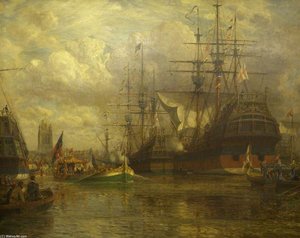
Parsons’ paintings are immediately recognizable for their atmospheric quality – a deliberate blurring of sharp edges and an emphasis on mood and feeling. He wasn't interested in merely replicating a scene; instead, he sought to convey the *experience* of being present within it. This is particularly evident in works like “The Launch Of The Great Western From Patterson’s Yard” (1899), where the energy of the harbor is rendered through thick, textured brushstrokes and a vibrant palette that captures both the brilliance of the sunlight and the muted tones of the fog. His use of impasto – applying paint thickly to create texture and visual interest – became a defining characteristic of his style, adding a tactile dimension to his landscapes.
Beyond mere landscape painting, Parsons imbued his work with subtle symbolism. The presence of ships, often depicted in moments of quiet contemplation or impending storm, suggests themes of human endeavor against the power of nature. His paintings of coastal towns like Crantock and Polperro are not simply picturesque views; they hint at a deeper connection to local history, folklore, and the rhythms of rural life. The artist’s fascination with Japanese prints is also evident in his compositions – particularly in their use of asymmetrical arrangements and flattened perspectives, creating a sense of visual harmony and tranquility.
Notable Works and Exhibitions
Parsons' career was marked by a consistent, though often understated, presence within the British art scene. He exhibited at several prestigious venues, including the Royal Academy, the Royal Society of British Artists, and the Royal Institute of Painters in Watercolours. However, he preferred to focus on smaller, more intimate exhibitions, showcasing his work in galleries across Bristol, Birmingham, Liverpool, Glasgow, and Manchester. Among his most celebrated paintings are “Queen Elizabeth Passing Down The Avon To Visit Hungroad” (1908), a dramatic depiction of the royal yacht navigating the River Avon, and "Durham Cathedral" (1911), which captures the imposing grandeur of the cathedral against a brooding sky. These works demonstrate his ability to blend historical subject matter with atmospheric realism and symbolic depth.
Legacy and Historical Context
Arthur Wilde Parsons’ contribution to British art is often overlooked, overshadowed by more flamboyant figures of the era. Yet, his quietly powerful paintings offer a valuable glimpse into the artistic sensibilities of late Victorian and Edwardian England. He was part of the Bristol Savages group, a collective of artists who challenged academic conventions and embraced a more expressive approach to landscape painting. Parsons’ work reflects the broader trends of the time – including the growing interest in plein air painting, the influence of Japanese art, and the rise of Impressionism – while maintaining a distinctly personal and regional identity. His paintings continue to resonate with viewers today, offering a poignant reminder of the beauty and power of the natural world and the enduring legacy of a Bristol artist who dedicated his life to capturing its essence.
Further information about Parsons can be found on the Art UK website: https://artuk.org/discover/artists/parsons-arthur-wilde-18541931
Ερωτήσεις και Απαντήσεις
Σε ποια πόλη και χώρα γεννήθηκε ο/η Arthur Wilde Parsons;
Ο/Η Arthur Wilde Parsons γεννήθηκε στην/στη Bristol, στο/στη United Kingdom.
Υπάρχει 3D εικονική περιήγηση στα έργα του Arthur Wilde Parsons;
Η 3D Μουσείο του Arthur Wilde Parsons σας προσφέρει μια εικονική τρισδιάστατη γκαλερί, όπου μπορείτε να θαυμάσετε τα έργα του καλλιτέχνη.
Πού μπορώ να δω τα έργα του/της Arthur Wilde Parsons σε χρονολογική σειρά;
Η σελίδα Χρονολόγιο Έργων του καλλιτέχνη παρουσιάζει τα έργα του Arthur Wilde Parsons ταξινομημένα ανά ημερομηνία, έτος προς έτος.