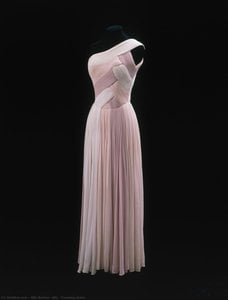
A Life Sculpted in Silk: The Enigmatic World of Madame Grès
Germaine Émilie Krebs, the woman who would become known as Madame Grès, was born into a middle-class Parisian family in 1903. From an early age, her artistic inclinations leaned towards sculpture—a desire to mold and shape form that would ultimately define her legacy, though not through stone or bronze, but through the fluid medium of fabric. Her parents discouraged this path, steering her toward dressmaking, a more “suitable” vocation for a young woman of her time. This early redirection proved pivotal; it didn’t extinguish her sculptural ambitions, but rather channeled them into an entirely new realm. She began her career as a hat maker, honing her skills before transitioning to couture dressmaking at the esteemed Maison Premet, where exacting standards and meticulous technique were paramount. These formative years instilled in her a dedication to craftsmanship that would become her hallmark.The Birth of a Signature: From Alix to Madame Grès
The evolution of her professional identity—from Mademoiselle Alix to Alix Barton and finally to Madame Grès—mirrors a deliberate crafting of persona, as carefully considered as the garments she created. The name “Grès” itself emerged in 1942 with her marriage to Russian painter Serge Anatolievitch Czerefkow, an anagram of his first name. This period was marked by both personal and professional challenges. Despite the turmoil of wartime Paris, Grès refused to compromise her artistic vision, continuing to design elegant dresses that subtly echoed the colors of the French flag—a quiet act of defiance that led to the temporary closure of her fashion house under German occupation. It was during this time, however, that her signature style truly crystallized: floor-length gowns draped with an unparalleled mastery, evoking the grace and timelessness of classical Greek sculpture.Draping as Art: A Revolutionary Technique
Madame Grès wasn’t merely designing dresses; she was sculpting them onto the body. Unlike many of her contemporaries who relied on pattern making, Grès preferred to work directly on a mannequin, manipulating fabric—primarily silk jersey and paper taffeta—with an almost intuitive understanding of its properties. This process was famously laborious, often requiring up to 300 hours for a single gown. Each pleat, twist, and fold was meticulously crafted by hand, allowing the fabric to conform to the contours of the body rather than imposing a rigid structure upon it. She described this as a “battle” between designer and medium, a constant negotiation between her vision and the inherent qualities of the material. This dedication to draping elevated dressmaking to an art form, earning her the moniker "the Sphinx of Fashion" for her secretive nature and unwavering focus on her craft.A Lasting Influence: Inspiring Generations
Throughout the 1940s and 50s, Madame Grès dressed some of the most iconic women of the era—the Duchess of Windsor, Paloma Picasso, Grace Kelly, Marlene Dietrich, and Greta Garbo among them. Her designs were characterized by their simplicity, elegance, and respect for the female form. She eschewed overt embellishment, allowing the beauty of the fabric and the artistry of her draping to speak for themselves. Her influence extended beyond the realm of haute couture, inspiring a new generation of designers with her innovative techniques and minimalist aesthetic. Azzedine Alaïa, in particular, was deeply captivated by Grès’s work, amassing a significant collection of her garments—a testament to his admiration and a recognition of her enduring legacy.The Queen of Drapery: A Timeless Vision
Madame Grès' impact on the fashion world remains profound. Her pioneering approach to draping, her unwavering commitment to craftsmanship, and her ability to transform fabric into wearable sculpture continue to inspire designers today. She wasn’t interested in fleeting trends; she sought to create timeless garments that celebrated the beauty of the human body and the artistry of couture. Her work stands as a powerful reminder that fashion can be more than just clothing—it can be a form of art, a testament to skill, and an expression of enduring elegance. Her minimalistic draping techniques and her attention to and respect for the female body have had a lasting effect on the haute couture and fashion industry.Ερωτήσεις και Απαντήσεις
Πώς μπορώ να παρακολουθήσω το έργο του/της Alix Barton, Alix χρονολογικά;
Μπορείτε να δείτε τη χρονολογία των έργων του/της Alix Barton, Alix στη σελίδα Χρονολόγιο Έργων, όπου τα έργα είναι ταξινομημένα ανά ημερομηνία δημιουργίας.
Πού μπορώ να επισκεφτώ μια 3D γκαλερί με τα έργα του/της Alix Barton, Alix;
Μια εικονική επίσκεψη είναι εφικτή: η σελίδα 3D Μουσείο του Alix Barton, Alix παρουσιάζει τα έργα του καλλιτέχνη σε μια τρισδιάστατη γκαλερί.
Πώς μπορώ να βρω όλα τα έργα του/της Alix Barton, Alix ανά είδος μέσου;
Για να βρείτε όλα τα έργα του/της Alix Barton, Alix ανά τεχνική, επισκεφθείτε τη σελίδα Κατά Τεχνική του καλλιτέχνη.