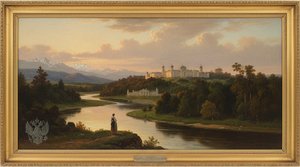
A Life Painted in Light: The Evocative Landscapes of Albert Żamett
Albert Wojciech Żamett, born on November 25th, 1821, in Vilnius, Lithuania, was a painter whose life and work beautifully bridged the worlds of Polish Romanticism and Russian academic tradition. His story is one of artistic pursuit fueled by patronage and shaped by extensive travel across Europe’s cultural heartlands. Żamett wasn't merely documenting landscapes; he was capturing fleeting moments of serenity and light, imbuing his scenes with a quiet emotional resonance that continues to captivate viewers today. His father, Daniel Schamett, originally from East Prussia, established himself as a Russian citizen in Vilnius, providing Albert with an upbringing steeped in both Polish heritage and the broader Imperial context. Żamett’s early artistic inclinations were nurtured during his time at a gymnasium in Vilnius and further developed through studies at the Academy of Fine Arts in St. Petersburg under Maxim Vorobiev – though he attended as a free listener, demonstrating an independent spirit from the outset.
From Vilnius to Italy: A Journey of Artistic Refinement
A pivotal moment in Żamett’s development arrived in 1847 with the generous support of Kaunas Marshal Benedict Tyszkiewicz. This patronage enabled him to embark on a transformative journey to Italy, followed by sojourns in France, England, and Germany. These travels were not simply geographical shifts; they represented an immersion into the artistic currents that would define his style. Italy, in particular, proved profoundly influential. He became captivated by the Italian light, the classical ruins, and the picturesque countryside – themes that would dominate his oeuvre for decades to come. This period marked a departure from purely academic training towards a more emotionally driven approach to landscape painting. Żamett wasn’t interested in meticulous topographical accuracy; he sought to convey the *feeling* of a place, the atmosphere, the sense of history and tranquility embedded within the scenery. His dedication was recognized in 1854 when he received an award from the Roman Academy of St. Luke for his landscape painting, solidifying his reputation as a rising talent.
Recognition and Return: Vilnius and Beyond
The accolades continued to accumulate; in 1859, Żamett was granted the title of academician by the St. Petersburg Academy of Arts, further cementing his standing within the Russian art establishment. This recognition prompted a return to Lithuania, where he became deeply involved in the cultural life of Vilnius. He served as a correspondent member of the Archaeological Commission and later as supervisor of the Art Department at the Antiquities Museum. However, Żamett’s artistic pursuits extended beyond painting. Between 1861 and 1863, he revisited France, England, and Savoy, continuing to refine his skills and broaden his artistic horizons. Upon his final return to Vilnius in 1864, he took on the responsibility of designing scenery for the Municipal Theater and even created frescos within the vestibule of the Cathedral of Vilnius – demonstrating a versatility that extended beyond canvas.
A Legacy Etched in Watercolor and Fresco
Żamett’s artistic output is characterized by a delicate watercolor technique, particularly evident in his depictions of Italian landscapes and scenes around Vilnius. His paintings are not grand statements; they are intimate reflections on the beauty of nature and the passage of time. Works like “Vilnius Surroundings. Bend” (1847), created in collaboration with Jan Kazimierz Wilczyński for inclusion in the *Album de Vilna*, showcase his ability to capture the subtle nuances of light and atmosphere. The lithographed versions of these watercolors, while not identical to the originals, provide valuable insight into the dissemination of his work during this period. His frescoes within Vilnius Cathedral, though less documented than his paintings, demonstrate his skill in adapting his artistic vision to a larger scale and different medium. Żamett’s influence extended beyond his own creations; he played a role in shaping the cultural landscape of Vilnius, fostering an appreciation for art and beauty within the community. He died on November 12th, 1876, and was buried at the cemetery of Evangelical Lutherans, leaving behind a legacy that continues to inspire artists and captivate audiences with its quiet elegance and evocative power.
Historical Significance: A Polish Artist in a Russian Context
Albert Żamett occupies a unique position within art history – a Polish artist working under the patronage of the Russian Empire, navigating a complex cultural landscape marked by both opportunity and constraint. His work reflects this duality, blending elements of Romantic sensibility with academic precision. He stands as a testament to the power of artistic vision to transcend political boundaries and connect across cultures. While his paintings often depict idyllic scenes far removed from the turmoil of 19th-century Europe, they nonetheless offer a glimpse into the aesthetic values and cultural aspirations of a specific time and place. His contributions to the Vilnius art scene were significant, helping to establish a vibrant artistic community and fostering an appreciation for landscape painting among local audiences. Today, Żamett’s work is increasingly recognized as a valuable contribution to both Polish and Lithuanian art history – a reminder of the enduring power of beauty and the importance of preserving cultural heritage.