A Symphony of Form: Decoding Fernand Léger’s *Composition* (1920)
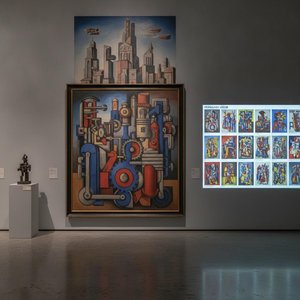
Fernand Léger's *Composition*, painted in 1920, is a pivotal work embodying the dynamism and spirit of post-World War I
modernism. Measuring 60 x 73 cm and currently housed at the
Kimbell Art Museum in Fort Worth, Texas, this
oil on canvas painting isn’t merely an aesthetic statement; it's a visual manifesto reflecting a world irrevocably changed by technology and conflict.
The Machine Age Aesthetic
*Composition* immediately captivates with its
fragmented forms and bold
geometric shapes.
Léger eschews traditional representation, instead constructing a scene from cylinders, cones, and planes – elements directly inspired by the burgeoning
industrial landscape. The dominant feature is a large, centrally positioned red and white wheel, appearing to rotate with an almost palpable energy. This isn’t a literal depiction of machinery, but rather its *essence* distilled into pure form. Smaller wheels and fragmented architectural components populate the canvas, creating a sense of depth and rhythmic movement.
Symbolism & The Post-War Psyche
The wheel, a recurring motif in
Léger’s oeuvre, carries multiple layers of meaning. It symbolizes not only the relentless progress of the
machine age but also the cyclical nature of life itself – birth, death, and renewal. Following his harrowing experiences during World War I,
Léger found inspiration in the very forces that fueled the conflict. The
mechanical forms represent a new order, a potential for rebuilding, and a fascination with the power and precision of technology.
The painting can be interpreted as an attempt to reconcile the trauma of war with a hopeful vision of the future.
Artistic Influences & Léger’s “Tubism”
Léger's artistic journey was profoundly shaped by his friendship with poet Blaise Cendrars, and their collaborative work – notably the illustrated book *I Have Killed* (1918) – explored themes of fragmentation and modernity. While deeply rooted in
Cubism,
Léger developed a distinct style often referred to as “Tubism,” characterized by its emphasis on cylindrical forms and simplified shapes. He moved away from the analytical fracturing of Picasso and Braque, embracing a more accessible and visually striking aesthetic. His work also reflects influences from
Futurism’s celebration of speed and technology, though tempered with a uniquely French sensibility.
Technique & Color Palette
Léger employed
oil paint with precision and control, creating smooth surfaces and sharply defined edges. The
color palette is bold and deliberately limited – primarily reds, whites, yellows, blues, and blacks – enhancing the painting’s graphic quality and emphasizing its formal structure.
The use of contrasting colors creates a sense of vibrancy and energy, drawing the viewer's eye across the canvas. He avoids traditional shading techniques, opting instead for flat planes of color that contribute to the overall sense of abstraction.
Historical Context & Legacy
*Composition* stands as a testament to
Léger’s contribution to
modern art. Created in the aftermath of WWI, it reflects the societal shifts and technological advancements of the era. His emphasis on condensation, variety, and fragmentation paved the way for future generations of artists, influencing movements like
Pop Art with its embrace of mass culture and mechanical imagery.
For Collectors & Interior Design
This painting’s
dynamic composition and striking
color palette make it a compelling focal point for any art collection or interior space. A reproduction of *Composition* would lend a sophisticated, modern edge to living rooms, offices, or galleries. Its abstract yet representational quality allows it to complement a wide range of décor styles – from minimalist to eclectic.
Fernand Léger’s *Composition* remains a powerful and enduring symbol of the modern age, inviting viewers to contemplate the relationship between humanity, technology, and the ever-changing world around us.
Ερωτήσεις και Απαντήσεις
Πού εκτίθεται σήμερα το "Σύνθεση" του Φερνάν Λεζέ;
Το πρωτότυπο έργο "Σύνθεση" του Φερνάν Λεζέ βρίσκεται στο Μουσείο Τέχνης Κίμπελ, Φορτ Γουόρθ, Ηνωμένες Πολιτείες της Αμερικής. Μια αναπαραγωγή σας επιτρέπει να εκθέσετε το έργο στο σπίτι σας.
Προς ποιο καλλιτεχνικό ρεύμα ανήκει το έργο "Σύνθεση" του Φερνάν Λεζέ;
Το έργο "Σύνθεση" του Φερνάν Λεζέ ανήκει στο καλλιτεχνικό κίνημα Κουβισμός. Αυτό το κίνημα παρέχει το στυλιστικό πλαίσιο του έργου.
Ποιο χρώμα κυριαρχεί στο "Σύνθεση";
Το κυρίαρχο χρώμα του έργου "Σύνθεση" του Φερνάν Λεζέ είναι το Γκρίζι-μπεζ putty (#cccac6).