Zhou Cunbo: A Weaver of Landscapes and Human Emotion
Zhou Cunbo, born in China in 1955, stands as a compelling figure within contemporary Chinese art, bridging the traditions of his heritage with a distinctly modern sensibility. His work, often characterized by its evocative landscapes and poignant portraits, reflects a deep engagement with both the natural world and the complexities of human experience. Initially shaped by the rigorous training of the Sichuan Academy of Fine Arts during the Cultural Revolution – an institution known for producing art serving as political propaganda – Cunbo’s artistic journey reveals a fascinating evolution, marked by a deliberate embrace of Western techniques alongside a steadfast connection to his roots. This synthesis is most powerfully demonstrated in his celebrated *Green Dog* series and subsequent explorations of themes like love and mortality.
Early Influences and the Socialist Realist Period
Cunbo’s formative years were deeply intertwined with the political climate of China, a period that profoundly shaped his artistic approach. His studies at the Sichuan Academy of Fine Arts instilled in him a foundational understanding of socialist realism – an aesthetic prioritizing idealized depictions of labor, heroism, and collective prosperity. During this time, he embarked on a significant journey to Tibet, documenting the lives of nomadic communities through a series of paintings. These works, characterized by their meticulous detail and adherence to the tenets of socialist realism, offered a glimpse into a world largely unseen by the broader population. However, even within this formally structured environment, Cunbo began to subtly experiment with techniques borrowed from Western art, laying the groundwork for his later stylistic shifts. The stark landscapes and figures of these early works demonstrate a remarkable ability to capture the essence of a culture while simultaneously reflecting the ideological imperatives of the era.
The *Green Dog* Series: A Fusion of Styles
A pivotal moment in Cunbo’s artistic development arrived with his creation of the *Green Dog* series, beginning in the 1990s. This ambitious project marked a dramatic departure from the conventions of socialist realism, embracing elements of German Expressionism and drawing upon personal symbolism. The central image – a vibrant green German Shepherd – quickly became an iconic representation of Cunbo himself, embodying themes of self-reflection, vulnerability, and perhaps even a touch of melancholy. The dynamic brushstrokes, reminiscent of artists like Ernst Ludwig Kirchner, create a sense of restless energy and emotional intensity, while the dog’s posture suggests both strength and a certain degree of isolation. This series established Cunbo as a significant voice in contemporary Chinese art, demonstrating his willingness to challenge artistic norms and explore deeply personal themes through a uniquely expressive visual language.
Beyond Portraits: Blossoms, Landscapes, and Symbolic Narratives
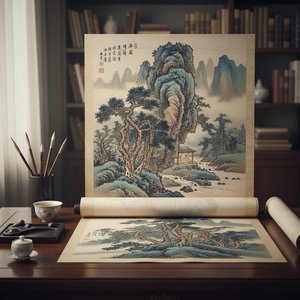
Following the success of the *Green Dog* series, Cunbo continued to expand his artistic repertoire, delving into new subject matter while retaining his signature stylistic approach. His exploration of traditional Chinese motifs, particularly the peach blossom – a symbol of longevity, beauty, and immortality – is particularly noteworthy. In works like “Peach Blossoms with Pink Men and Women in an Embrace,” Cunbo seamlessly blends the symbolic weight of this ancient imagery with a contemporary sensibility, creating images that are both visually arresting and emotionally resonant. Similarly, his landscape paintings, often characterized by their muted color palettes and jagged forms, evoke a sense of timelessness and contemplation. These works suggest a deep connection to the natural world and a profound awareness of its enduring power.
Legacy and Recognition
Zhou Cunbo’s artistic journey has been marked by consistent critical acclaim and widespread recognition both within China and internationally. His work has been exhibited in prestigious galleries and museums, including the Shanghai Gallery of Art, the National Art Museum in Beijing, and the Museum of Fine Arts in Houston. A retrospective exhibition at the Shanghai Art Museum in 2010 provided a comprehensive overview of his career, solidifying his position as one of China’s most important contemporary artists. Cunbo's ability to synthesize traditional Chinese aesthetics with modern artistic techniques, coupled with his profound engagement with universal themes of identity, mortality, and beauty, ensures that his work will continue to resonate with audiences for years to come. His legacy lies not only in the captivating imagery he creates but also in his courageous exploration of personal and cultural narratives through a uniquely expressive visual language.