A Life Dedicated to Genre and Portraiture: The World of Willem Hendrik Schmidt
Willem Hendrik Schmidt, born in Rotterdam in 1809, was a Dutch painter who carved a niche for himself within the artistic landscape of the 19th century. Though not as widely celebrated as some of his contemporaries, Schmidt’s dedication to genre scenes and portraiture offers a fascinating glimpse into the everyday life and burgeoning middle class of his time. His journey began somewhat unconventionally; initially involved in his father's business, he felt an undeniable pull towards artistic expression, eventually abandoning commerce for the canvas in 1835. This decision marked the beginning of a career defined by meticulous detail, emotional resonance, and a growing mastery of both oil paint and lithography.
Early Training and Artistic Development
Schmidt’s formal training was multifaceted, reflecting his commitment to honing his skills across various disciplines. He first studied with Hendrik Schaaff in Leeuwarden, laying the foundational groundwork for his artistic endeavors. This was followed by periods of instruction under Jacobus Schoemaker Doyer in Amsterdam and, crucially, Willem Hendrik Schmidt Sr. in Delft – a potential relative whose influence remains somewhat obscured but undoubtedly shaped the young artist’s early style. From 1848 to 1852, he further refined his technique at the Royal Academy of Art in The Hague, an institution renowned for its rigorous standards and emphasis on realism. A subsequent sojourn to Paris and lessons with Charles Gleyre broadened his horizons, exposing him to new artistic currents and approaches that would subtly inform his later work.
Themes and Techniques: Capturing the Essence of Dutch Life
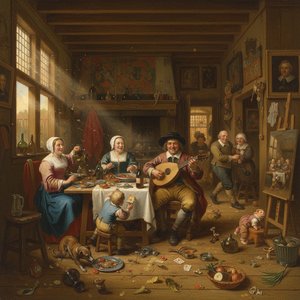
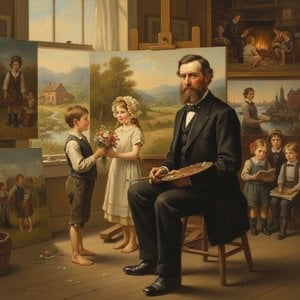
Schmidt’s oeuvre is characterized by a focus on genre scenes – depictions of everyday life, often featuring domestic interiors or intimate moments between family members. These paintings weren't merely observational; they were imbued with a quiet dignity and psychological depth. He possessed an exceptional ability to capture the subtle nuances of human emotion, rendering his subjects with remarkable sensitivity. “The Resuscitation of Jairus’s Daughter”, one of his most recognized works, exemplifies this talent – a poignant portrayal of faith, grief, and hope. Beyond genre scenes, Schmidt also excelled as a portraitist, creating likenesses that were not simply representations of physical appearance but rather insightful studies of character. His technique was marked by precision and attention to detail, employing a smooth brushstroke and a restrained palette that emphasized form and light. He wasn’t afraid to experiment with watercolor and lithography either, demonstrating versatility across different mediums.
Recognition and Legacy
Throughout his career, Schmidt garnered recognition for his artistic achievements. His appointment as a member of the Royal Academy in Amsterdam in 1837 signaled his growing reputation within the Dutch art world. He exhibited widely – not only in the Netherlands but also in France, England, and even the United States, broadening his reach and establishing himself on an international stage. In 1863, he was bestowed with the honor of being named a Knight in the Order of the Oak Crown, a testament to his contributions to Dutch art and culture. He married Catharina Swift in 1869 and settled in Scheveningen, continuing to paint and teach until his death in The Hague in 1904. Schmidt was an active member of both the Pulchri Studio and the Hollandsche Teekenmaatschappij, further solidifying his position within the artistic community. He also generously shared his knowledge with numerous students, including Christoffel Bisschop and Johannes Tavenraat, ensuring that his legacy would endure through subsequent generations of artists. While perhaps not a household name today, Willem Hendrik Schmidt’s work remains a valuable contribution to 19th-century Dutch painting, offering a compelling window into the social fabric and artistic sensibilities of his era.