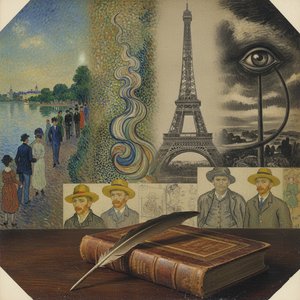
A Pioneer of Southeast Asian Modernism: Wee Kong Chai
Wee Kong Chai (1928 – Present) occupies a prominent position in Malaysian art history, representing the fervent spirit of artistic exploration during the mid-20th century and forging powerful connections between Eastern traditions and Western artistic advancements. Born in Kuala Lumpur, Chai’s formative years were profoundly shaped by encountering both colonial legacies and burgeoning nationalist sentiments—a duality that irrevocably molded his artistic vision. His initial education at the Singapore Academy of Arts instilled a foundational comprehension of European art movements while simultaneously nurturing an appreciation for Malaysian cultural narratives—a synthesis that would define his oeuvre.
Early Influences: The Impressionist Spark
Chai’s artistic journey commenced with an ardent fascination for Impressionism and Post-Impressionism, particularly the works of Cézanne and Picasso. These artists championed expressive brushwork and simplified forms – principles he skillfully assimilated into his distinctive style. Cézanne's geometric reduction served as a guiding force, encouraging Chai to distill complex subjects into essential visual elements. Simultaneously, Picasso’s cubist explorations instilled an awareness of fragmented perspectives and challenging conventional representations—influences that would permeate his artistic process. This initial exposure established a bedrock of stylistic considerations that would underpin his subsequent endeavors.
Parisian Exploration: Embracing Surrealism & Expressionism
Recognizing the imperative for expanding artistic horizons, Wee Kong Chai undertook a transformative relocation to Paris in 1964. He enrolled at École Nationale Supérieure des Beaux-Arts, immersing himself completely within the vibrant intellectual and artistic atmosphere of the time—a crucible where avant-garde ideas flourished. During this pivotal period, he engaged intensely with Surrealism and Abstract Expressionism, furthering refining his technique and deepening his conceptual understanding. Artists like Joan Miró and Jackson Pollock served as inspiration, encouraging Chai to experiment with unconventional materials and processes – a deliberate departure from academic conventions. This immersion solidified his commitment to pushing artistic boundaries.
Signature Works: Parisian Scenes & Cultural Storytelling
Chai’s artistic output is characterized by a captivating fusion of meticulous observation and imaginative interpretation. His celebrated paintings, such as ‘A Scene in Paris,’ exemplify this approach—capturing the essence of urban life with painstaking detail yet imbued with an underlying sense of poetic abstraction. These canvases transcend mere representation; they embody dialogues between reality and emotion, reflecting Chai’s profound engagement with the human condition. The artist skillfully employs color palettes – often muted yet luminous – to evoke mood and memory. Similarly, ‘Storyteller,’ showcases his remarkable ability to convey cultural heritage through visual storytelling—drawing inspiration from Malaysian folklore and traditions. He meticulously renders symbolic motifs and narratives, conveying complex ideas through simplified forms.
Historical Significance & Legacy
Wee Kong Chai stands as a cornerstone of Malaysian art history, embodying the spirit of modernist experimentation during a period of significant social and political change. His stylistic innovations – characterized by geometric reduction and expressive brushwork – resonated with artists across Southeast Asia, establishing a precedent for artistic exploration rooted in cultural identity. He championed a visual language that prioritized emotional resonance alongside intellectual rigor—a stance that continues to inspire contemporary artists today. Wee Kong Chai’s enduring contribution lies not only in his individual artworks but also in shaping the trajectory of Malaysian art into the latter half of the 20th century and beyond.