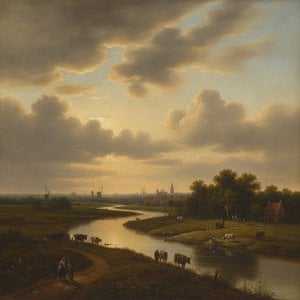
Samuel Dirksz van Hoogstraten: A Master of Illusion and Intellect
Samuel Dirksz van Hoogstraten (1627-1678) stands as a towering figure in the annals of Dutch Golden Age art, an artist whose legacy extends far beyond his stunning visual creations. He wasn’t merely capturing scenes from his era; he was dissecting them, manipulating perception, and exploring the very essence of artistic representation—a pursuit that cemented his place as one of the most influential thinkers and practitioners of Baroque painting in Holland. Born in Dordrecht, Netherlands, into a family steeped in artisanal tradition – his father a silversmith and painter, his grandfather a guild member – Van Hoogstraten’s formative years instilled within him an appreciation for craftsmanship and a keen understanding of visual principles that would inform his entire artistic career.Early Training and Rembrandt's Influence
His formal artistic education began under the tutelage of his father, Dirk van Hoogstraten, grounding him in the foundational techniques of painting before he embarked on his apprenticeship with Rembrandt Harmenszoon van Rijn around 1640. This association proved transformative, exposing Van Hoogstraten to Rembrandt’s groundbreaking approach to chiaroscuro—the dramatic interplay of light and shadow—a technique that would become a hallmark of his own style. Unlike many artists of his time who slavishly imitated their masters, Van Hoogstraten possessed an inquisitive mind and a restless spirit that propelled him beyond mere replication. He meticulously studied Rembrandt’s compositions, analyzing the subtleties of tonal gradation and exploring how light could convey emotion and create illusionistic depth. This dedication to Rembrandt's method is evident in his early portraits, where he skillfully employs chiaroscuro to sculpt form and imbue his subjects with psychological nuance.A Journey Through Europe: Observation and Innovation
Driven by an unwavering desire for artistic advancement, Van Hoogstraten undertook extensive travels throughout Europe during the 1650s and early 1660s—a period marked by intellectual ferment and artistic experimentation. He visited Vienna, Rome, and London, immersing himself in diverse artistic traditions and absorbing influences from artists such as Johannes Vermeer and Pieter de Hooch. These journeys weren’t merely sightseeing expeditions; they were intensive studies of architecture, perspective, and the prevailing aesthetic sensibilities of each locale—observations that profoundly shaped his artistic vision. He meticulously documented his findings in notebooks filled with sketches and diagrams, demonstrating a commitment to scientific inquiry alongside artistic creativity. This meticulous attention to detail is particularly apparent in his architectural paintings, where he employs precise mathematical calculations to achieve breathtaking realism and convey spatial illusion.The Triumph of Trompe-l’œil and Perspective Boxes
Perhaps Van Hoogstraten's most remarkable achievement was his mastery of trompe-l’œil—the art of deceiving the eye—a technique that he elevated to unprecedented heights. He skillfully crafted illusions within still lifes, creating seemingly three-dimensional representations of objects that defied conventional perspective. His celebrated “Peepshow with Views of the Interior of a Dutch House,” housed at the National Gallery in London, exemplifies this innovative approach, transporting viewers into miniature worlds rendered with astonishing accuracy and depth. Similarly, he constructed perspective boxes—elaborate architectural models designed to simulate realistic interiors when viewed through peepholes—demonstrating his profound understanding of spatial illusion and challenging viewers’ perceptions of reality. These creations weren't merely decorative objects; they were intellectual puzzles that demanded careful observation and contemplation.A Theoretician's Legacy: Shaping Artistic Discourse
Beyond his artistic accomplishments, Van Hoogstraten was a prolific art theorist who sought to codify the principles of painting in his magnum opus, *Inleyding tot de hooge schoole der schilderkonst* (Introduction to the Academy of Painting), published in 1678. This ambitious treatise stands as one of the most comprehensive and intellectually rigorous explorations of art theory produced in the Dutch Republic during the Baroque era—a testament to his erudition and unwavering dedication to advancing artistic knowledge. Van Hoogstraten drew upon a vast range of sources, from classical philosophy to contemporary treatises on optics, analyzing issues of pictorial persuasion, illusionism, moral responsibility, and the relationship between painting and intellect. He built upon the foundations laid by Karel van Mander in his earlier work, *Het Schilder-Boeck*, aiming to establish a systematic framework for understanding and practicing the art of painting—a legacy that continues to inspire artists and scholars alike. His writings reflect both international influences gleaned from his travels and debates within Dutch artistic circles, securing his place as a pivotal figure in shaping the intellectual landscape of his time.Fragen & Antworten
Welche Farben hat Samuel van Hoogstraten am häufigsten verwendet?
Das Farbprofil der Werke von Samuel van Hoogstraten wird auf der Farbgenom der Palette-Seite des Künstlers angezeigt.
Wo sind die nach Themen sortierten Kunstwerke von Samuel van Hoogstraten zu finden?
Die Seite Themenatlas ordnet die Kunstwerke von Samuel van Hoogstraten nach Themen an.
Gibt es eine vollständige Liste der Kunstwerke von Samuel van Hoogstraten?
Alle Werke von Samuel van Hoogstraten auf diese Website können auf der Alle Kunstwerke-Seite des Künstlers durchstöbert werden.