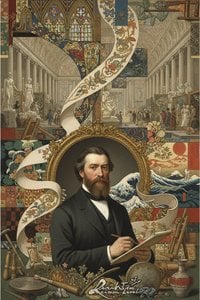
Rudolph Ackermann: Pioneer of Regency Printmaking and Urban Landscape
Rudolph Christian Karl Friedrich Ackermann (1764 – 1834) stands as a pivotal figure in the history of British printmaking during the Regency era, transforming London’s visual culture through his innovative lithographic techniques and meticulous depictions of city life. Born in Stollberg, Saxony, he possessed an uncommon blend of entrepreneurial spirit and artistic vision—qualities that propelled him from humble beginnings to become one of the most influential publishers and artists of his time.
Early Life and Education Despite facing obstacles due to familial finances, Ackermann pursued a formal education at the Latin School in Stollberg, recognizing the importance of scholarly grounding. However, he ultimately abandoned higher academic pursuits, opting instead for a practical apprenticeship as a saddler—a craft that instilled in him a keen eye for detail and craftsmanship—before relocating to London at the age of twenty-three. This move proved transformative, establishing him within the burgeoning commercial landscape of the capital and affording him opportunities to hone his skills as a coachmaker, designing the ceremonial carriage for the Lord Chancellor of Ireland.
Career in Printmaking and Publishing Ackermann’s innate business acumen quickly recognized the potential of printmaking as a medium for disseminating knowledge and capturing the spirit of an age. In 1795, he founded a print-shop and drawing-school at 96 Strand, marking the genesis of his enduring legacy. Driven by ambition and fueled by astute observation, Ackermann swiftly established himself as a leader in the field, mastering lithography—a revolutionary printing process that allowed for unprecedented precision and tonal range—and venturing into related trades like color printing and paper manufacturing. His workshop’s expansion necessitated relocation to 101 Strand, placing him strategically near the Royal Academy of Arts, fostering collaborations with prominent artists such as Thomas Rowlandson and Isaac Cruikshank, and cementing his position at the forefront of artistic innovation. Ackermann's publications—most notably “The Repository of Arts, Literature, Fashions”—became invaluable documents chronicling the stylistic trends shaping Regency society, reflecting a fascination with classical ideals blended with contemporary sensibilities. He skillfully utilized lithography to achieve remarkable tonal effects, capturing the nuances of light and shadow in his prints with unparalleled accuracy.
Notable Works and Contributions Ackermann’s artistic output encompassed a diverse range of subjects, demonstrating his versatility as an engraver and illustrator. Among his most celebrated achievements are “Fashion Plate,” capturing the elegance of Regency dress; “The English Dance of Death,” a hauntingly beautiful engraving by Rowlandson that explored themes of mortality with masterful artistry; and "The Microcosm of London," a monumental three-volume series presenting detailed panoramas of London’s streets and buildings—a testament to Ackermann's dedication to documenting the urban environment. His meticulous attention to detail, combined with his innovative use of lithography, profoundly influenced subsequent generations of printmakers and contributed significantly to shaping perceptions of Victorian London.
Historical Significance Ackermann’s influence extended beyond mere artistic production; he actively championed the advancement of printmaking as a profession and fostered collaborations that propelled British art into new directions. His unwavering commitment to excellence established him as a cornerstone of Regency visual culture, leaving an indelible mark on the aesthetic landscape of his era and securing his place among the most important figures in British art history. He remains remembered not only for his stunning prints but also for his role in nurturing artistic talent and shaping the cultural narrative of London during its golden age. His legacy continues to inspire artists and art enthusiasts alike, reminding us of the transformative power of observation and innovation within the realm of visual arts.