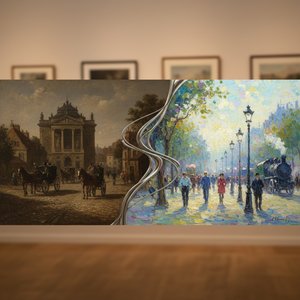
Rita Kernn-Larsen: Bridging Surrealism and Landscape
Rita Kernn-Larsen (1 January 1904 – 10 April 1998) stands as a singular figure in Danish surrealist art history—a woman who defied convention, embraced both fantastical imagery and the stark realities of wartime experience, and ultimately found solace in the tranquil beauty of Provence. Born into a prosperous family in Hillerød, Denmark, her artistic journey began early, nurtured by private instruction and fueled by an innate fascination with visual expression. This formative period instilled a foundational appreciation for meticulous observation alongside imaginative exploration—a duality that would characterize her entire oeuvre.
Her formal training at the Royal Danish Academy of Fine Arts proved disappointing; Kernn-Larsen found its curriculum too restrictive, prioritizing academic precision over the liberating spirit of artistic experimentation. Recognizing this misalignment, she sought inspiration abroad in Oslo, Norway, immersing herself in a vibrant cultural milieu before embarking on a transformative relocation to Paris in 1933. It was here that she encountered Fernand Léger’s academy, where her artistic sensibilities were honed under Léger's guidance until 1933—a period marked by stylistic evolution toward a more decorative aesthetic. However, Kernn-Larsen swiftly abandoned this initial approach, gravitating towards the burgeoning Surrealist movement and its exploration of subconscious thought.
The influence of André Breton and Surrealism is palpable throughout her artistic output, particularly evident in works like “Fantomerne” (Phantoms), where ghostly figures intertwine with meticulously rendered landscapes—a deliberate juxtaposition reflecting Kernn-Larsen’s belief that dreams could illuminate the hidden truths beneath everyday appearances. Her participation in the London International Surrealist Exhibition of 1936 solidified her position within the movement, showcasing her talent alongside fellow artists and establishing her reputation as one of Denmark's foremost female surrealists. During World War II, Kernn-Larsen’s artistic focus shifted away from fantastical visions toward a more grounded portrayal of wartime life—a poignant reflection of the anxieties and uncertainties experienced by ordinary people during that tumultuous era. Her collaboration with Jewish art dealer Isaac Grünberg provided invaluable support during this period.
Beyond her engagement with Surrealism, Kernn-Larsen possessed a remarkable sensitivity to the natural world, capturing the serene landscapes of Provence in paintings imbued with subtle color palettes and evocative compositions. This stylistic shift—away from the elaborate dreamscapes of her early years—demonstrated her adaptability as an artist and her ability to distill profound emotion into visual form. Her work continues to inspire admiration for its blend of imagination and realism, cementing her place as a pivotal figure in Danish art history.
Her legacy extends beyond her artistic creations; Kernn-Larsen championed the role of women in the arts, advocating for greater visibility and recognition within the creative community—a testament to her unwavering commitment to artistic freedom and intellectual curiosity. Rita Kernn-Larsen’s enduring influence can be seen in the work of subsequent generations of artists who embraced both surrealist principles and a deep appreciation for the beauty of the natural environment.