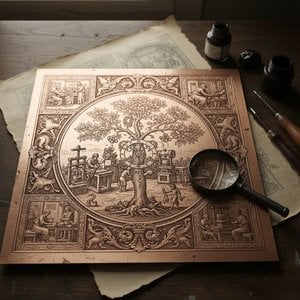
Pierre Nicolas Ransonnette After Louis-François Cassas: A Vision of Renaissance Architecture
Pierre Nicolas Ransonnette (1745 – 1810) embodies the spirit of the French Enlightenment, a period captivated by classical ideals and driven by intellectual curiosity. Though often overshadowed by his mentor, Louis-François Cassas—a celebrated architect and diplomat who served as ambassador to Constantinople—Ransonnette achieved considerable renown as an engraver, producing exquisitely detailed prints that captured the majesty of architectural designs and solidified Cassas’s legacy.
Early Life & Artistic Foundations
Born in Paris around 1745, Ransonnette's artistic journey commenced under the guidance of Pierre-Philippe Choffard, a respected printmaker whose expertise instilled within him an unwavering commitment to etching techniques. This formative influence profoundly shaped his stylistic sensibilities and ensured that his subsequent creations possessed exceptional precision—a hallmark of his oeuvre. Choffard’s meticulous craftsmanship served as a bedrock for Ransonnette's own artistic endeavors, fostering a dedication to accuracy that would define his career.
Cassas’s Patronage: Shaping Artistic Vision
Louis-François Cassas’s patronage exerted an undeniable impact on Ransonnette’s artistic sensibilities. Cassas’s ambitious architectural projects—particularly the daring reconstruction plans for the Temple of Baalshamin in Istanbul—presented Ransonnette with unparalleled opportunities to hone his skills and explore innovative methods for portraying complex architectural forms. This collaboration fostered a shared fascination with humanist principles and fueled Ransonnette's desire to translate Cassas’s visionary ideas onto paper, resulting in prints that mirrored the architect’s grandeur.
The Temple of Baalshamin: A Masterpiece of Engraving
Ransonnette’s most enduring achievement resides in his etching ‘Temple of Baalshamin, Plan and Reconstruction.’ This monumental print exemplifies Cassas’s audacious reimagining of Byzantine splendor—a bold assertion of classical ideals infused with humanist thought. Ransonnette's painstaking attention to detail ensured that every subtle nuance of Cassas’s design was faithfully reproduced on paper, transforming the architectural plan into a captivating visual experience. The resulting image stands as a testament to Ransonnette’s technical prowess and his ability to convey Cassas’s artistic vision with breathtaking realism.
Technique & Stylistic Characteristics
Ransonnette's etching style distinguishes itself through exceptional tonal subtlety and remarkable precision. He skillfully manipulated pen and ink, complemented by delicate washes of gray and blue—a technique perfected under Choffard’s tutelage—to delineate architectural contours and textures with unparalleled realism. Unlike mere representations, Ransonnette’s prints functioned as immersive explorations of Cassas's architectural concepts, transporting viewers into the heart of Renaissance grandeur. His meticulous approach cemented his reputation as one of France’s foremost engravers and secured his place within the artistic canon of his era.
Legacy & Historical Significance
Ransonnette’s work reflects the broader intellectual currents of the Enlightenment—a period characterized by a fervent revival of classical learning and an aspiration to elevate art as a vehicle for disseminating knowledge. Alongside Cassas' architectural endeavors, Ransonnette’s prints stand as emblems of Enlightenment ambition and artistic excellence, securing his place within the annals of French art history and demonstrating the enduring power of meticulous craftsmanship to capture and convey profound ideas.
Explore the intricate world of etching and intaglio printmaking. Discover how masters use acid and metal to create profound textures and lines, from Romanticism to modern era, through an expert lens of art history and technical mastery.
WConciergeOnline · antwortet innerhalb einer Minute
Hallo! Ich kann Ihnen dabei helfen, ein Kunstwerk auszuwählen, eine Bestellung zu verfolgen oder Fragen zur Garantie zu beantworten. Wie kann ich Ihnen heute behilflich sein?