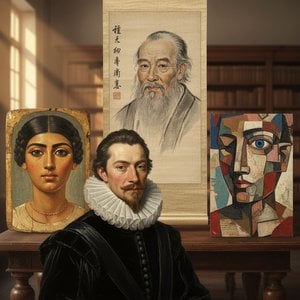
The Chronicle of a Face: Unveiling the Art of Pichat Olivier
Pichat Olivier, a name resonating within circles dedicated to historical portraiture, stands as a compelling figure in contemporary realism. While biographical details remain somewhat elusive – a characteristic perhaps fitting for an artist so focused on capturing the essence of those *already* etched into history – his work speaks volumes. Emerging from WahooArt’s network of skilled artisans, Olivier has carved a niche portraying figures central to the Napoleonic era and beyond, breathing new life into the visages of emperors, generals, and prominent personalities of 19th-century France. He isn't merely replicating images; he is engaging in a dialogue with time itself, meticulously reconstructing not just likenesses but also the aura of power, intellect, and circumstance that defined his subjects.
A Master of Historical Reconstruction
Olivier’s artistic prowess lies in his remarkable ability to synthesize historical accuracy with painterly finesse. His canvases are not simply portraits; they are carefully researched visual narratives. Each uniform button, each fold of drapery, each subtle expression is rendered with painstaking detail, reflecting a deep immersion into the period he depicts. He draws upon extensive study of original sources – military records, contemporary accounts, and existing portraiture – to ensure authenticity. However, Olivier transcends mere imitation. His paintings possess a warmth and vitality often absent in earlier, more formal representations. There’s a palpable sense of *presence* in his subjects, as if they are about to step off the canvas and engage with the viewer. This is achieved through masterful use of light and shadow, creating depth and volume that imbue each portrait with a striking three-dimensionality. He often employs a rich, classical palette, favoring earth tones and muted colors that evoke the grandeur and solemnity of the era.
Influences and Artistic Development
While pinpointing specific artistic mentors proves difficult given the limited biographical information available, Olivier’s work clearly demonstrates an affinity for the traditions of French academic painting. The influence of artists like Jacques-Louis David – renowned for his Neoclassical portraits of Napoleon – is readily apparent in Olivier's emphasis on precise draftsmanship and heroic composition. However, he also exhibits a sensitivity to Romantic ideals, particularly in his ability to convey emotion and psychological depth. His brushwork, while controlled, isn’t devoid of expressiveness; it reveals a nuanced understanding of human anatomy and the subtle interplay of light and form. It is likely that Olivier's development involved a rigorous study of Old Master techniques, honing his skills through meticulous copying and observation. The result is a style that seamlessly blends classical rigor with Romantic sensibility, creating portraits that are both historically accurate and emotionally resonant.
The Napoleonic Focus: A Legacy in Paint
Olivier’s most celebrated works center around the Napoleonic era. He has immortalized Napoleon Bonaparte himself in numerous guises – as First Consul, Emperor, and in moments of strategic contemplation. But his focus extends beyond the emperor to encompass a wide range of figures who shaped this tumultuous period: Marshals Ney, Murat, and Soult; members of the Imperial family; and key political advisors. This dedication to portraying the Napoleonic circle suggests more than just an interest in military history. It speaks to a fascination with power dynamics, ambition, and the complexities of leadership. His portraits are not simply celebrations of glory; they offer nuanced glimpses into the personalities of these individuals, revealing their strengths, weaknesses, and inner turmoil.
Historical Significance and Contemporary Relevance
In an age dominated by abstraction and conceptual art, Pichat Olivier’s commitment to representational painting is a powerful statement in itself. He reminds us of the enduring power of portraiture – its ability to connect us with the past and offer insights into the human condition. His work serves as a valuable historical resource, providing visually compelling representations of figures who shaped modern Europe. Moreover, his paintings appeal to a broader audience, captivating viewers with their beauty, technical skill, and emotional depth. Olivier’s art is not confined to museums or private collections; through platforms like WahooArt, his portraits are accessible to a global audience, ensuring that the legacy of these historical figures – and the artistry of Pichat Olivier himself – continues to thrive in the 21st century.
- Style: Realism, Historical Portraiture
- Key Subjects: Napoleonic Era Figures, Military Leaders, French Aristocracy
- Influences: Jacques-Louis David, Romantic Painting Traditions, Old Master Techniques
- Notable Characteristics: Meticulous Detail, Historical Accuracy, Emotional Depth, Classical Palette
“To paint a portrait is not merely to reproduce an image; it is to capture the soul.” – A sentiment echoed in every brushstroke of Pichat Olivier’s masterful work.