The Legacy of Paracas Culture
The Paracas culture, flourishing between approximately 800 BCE and 100 BCE along Peru’s arid Pacific coast, represents a remarkable achievement in Andean art and craftsmanship. Primarily known for its breathtaking textiles—considered among the finest ever produced by pre-Columbian societies—the culture also left an indelible mark on ceramic artistry, reflecting their sophisticated understanding of materials and techniques. Excavations at sites like Wari Kayan and the Paracas Peninsula have yielded invaluable insights into this enigmatic civilization.
Origins and Environment
Located in what is now the Ica Region, the Paracas people thrived in a challenging environment characterized by extreme aridity and proximity to the ocean. This landscape profoundly shaped their worldview and artistic expression. The scarcity of resources necessitated innovative solutions for survival—particularly in agriculture—but it also fostered a rich cultural heritage centered on ritualistic practices and elaborate social organization. Evidence suggests that these communities practiced complex irrigation systems, demonstrating an impressive mastery of engineering skills. Imagine living in the driest desert on earth located next to the richest ocean on earth. How would these extremes shape social and religious life? What kind of mythology would the drama of this landscape generate? Some ideas can be found in an ancient south coastal Peruvian people now known as Paracas, from the later Quechuan dialect to “sand falling like rain.” Paracas refers to both an arid south coastal peninsula and the culture that thrived in the region c. 700 B.C.E. – 540 C.E. The area is a starkly beautiful desert of ochre red, yellow, and gold sediments juxtaposed with the vivid Pacific Ocean. The ocean, enriched by the icy Peruvian current, is a haven for marine life. Ancient inhabitants, likely drawn to the ocean’s resources, had to make do with small coastal rivers trickling down from the Andes for fresh water and agricultural opportunities. In this environment, with visual contrasts so extreme the landscape approaches Color Field abstraction—a technique pioneered by artists like Mark Rothko—the Paracas elevated textile art to some of its highest levels of sophistication, and had the longest continuous tradition of textile art in history.
Textile Art: A Symbol of Ritual and Status
The Paracas necropolis stands as testament to the unparalleled skill of Paracas weavers. Burial sites—particularly the Shaft Tombs of Cerro Colorado—contain meticulously crafted textiles wrapped around deceased individuals, often seated in a posture facing north across the bay. These textiles are adorned with intricate geometric patterns—primarily stylized fish motifs—and employ remarkable weaving techniques that combine horizontal and vertical threads to create incredibly dense fabrics. The colors employed were derived from natural pigments extracted from plants and minerals, resulting in vibrant hues that endure to this day. Beyond mere decoration, these textiles served as powerful symbols of status and spiritual beliefs, reflecting the deceased’s position within the social hierarchy and their connection to ancestral spirits. Researchers have discovered that the weaving techniques used by Paracas artisans were remarkably advanced for their time—a feat achieved without the aid of modern tools or machinery. The meticulous preservation of burial sites—particularly the Shaft Tombs—provides invaluable evidence for reconstructing Andean funerary rituals. These textiles are considered to be some of the most accomplished fiber arts ever created.
Ceramic Innovation: Negative Resist Decoration
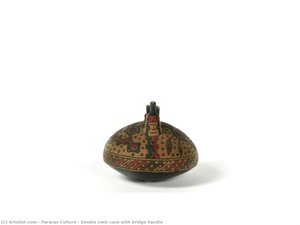
Paracas ceramics are equally impressive for their artistic innovation. Unlike many other Andean cultures that utilized positive resist techniques—where pigment is applied to protect areas from staining—the Paracas employed negative resist decoration. This method involved applying a thin layer of clay over a surface decorated with incised designs, then removing the exposed clay to reveal the underlying pattern. The resulting surfaces are remarkably smooth and polished, showcasing exceptional craftsmanship. Furthermore, Paracas ceramics exhibit distinctive patterns—such as ‘checkerboard’ designs—that appear to be influenced by Nazca culture, suggesting cultural exchange between these two prominent Andean societies. These innovations demonstrate a profound understanding of material science and artistic expression.
Historical Significance and Enduring Influence
The Paracas culture's legacy extends far beyond its artistic achievements. Archaeological discoveries continue to illuminate aspects of their daily life, social structure, and religious beliefs. The meticulous preservation of burial sites—particularly the Shaft Tombs—provides invaluable evidence for reconstructing Andean funerary rituals. Moreover, the exquisite textiles produced by Paracas artisans have captivated scholars and artists alike, inspiring reinterpretations in contemporary art forms. Their mastery of weaving techniques remains a source of fascination and admiration, demonstrating the enduring power of ancient Andean artistry to resonate with audiences across time and space. The Paracas culture’s contribution to textile arts is recognized as one of the most accomplished fiber arts ever created.