Early Life and Education
Niles Spencer, an American painter of the Precisionist school, was born on May 16, 1893, in Pawtucket, Rhode Island. He pursued his artistic ambitions diligently from a young age, immersing himself in studies at the Rhode Island School of Design between 1913 and 1915. This formative period instilled within him a foundational understanding of artistic principles and techniques. Subsequently, he honed his skills further at the Ferrer School in New York City, where Robert Henri and George Bellows imparted invaluable guidance on composition and visual storytelling. These influential mentors shaped Spencer’s artistic vision and propelled him toward mastery of his chosen craft.Artistic Style and Influences
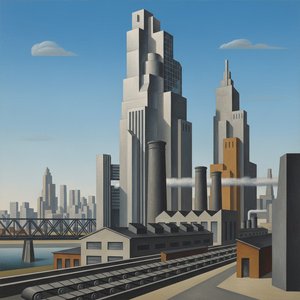
Spencer's distinctive artistic style emerged from a profound engagement with European Cubism—a movement that captivated him during his travels to Europe in 1921-22 and again in 1928-1929. The geometric forms and fractured perspectives characteristic of Cubist painting resonated deeply with Spencer’s sensibilities, prompting him to experiment with innovative approaches to representation. This exposure fueled his exploration of abstraction while simultaneously grounding it in meticulous observation of the natural world.Notable Works
Spencer's oeuvre is marked by a remarkable concentration on industrial landscapes and architectural structures—subjects that he tackled with unwavering precision and clarity. Among his most celebrated achievements are “Erie Underpass” (1940), a poignant depiction of an urban railway bridge bathed in twilight, capturing the solemn beauty of industrial decay.“The Dormer Window” (1927) exemplifies Spencer’s early stylistic explorations, presenting a bold visual abstraction that anticipates the developments of his mature style. His monumental mural for the United States Post Office in Aliquippa, Pennsylvania (“Western Pennsylvania”), completed in 1938, stands as a testament to his commitment to large-scale public art projects and his ability to convey complex narratives through simplified forms.