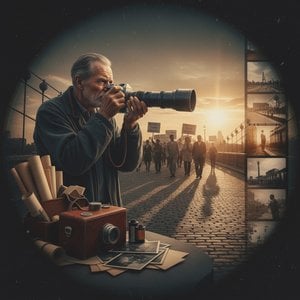
Myung-duk Chu: Capturing the Soul of Korean Everyday Life
Myung-duk Chu (born Seoul, South Korea, 1966) stands as a prominent figure in contemporary Korean photography, renowned for his masterful black and white images that distill the essence of daily life within South Korea. His artistic vision transcends mere documentation; instead, he strives to evoke emotion and contemplation through carefully composed scenes that reveal subtle narratives embedded within seemingly unremarkable moments.
Chu’s journey into photography began amidst a period of significant social change in Korea—the 1960s—as he honed his skills at The Scenes Magazine publisher. This formative experience instilled in him a dedication to capturing the spirit of his time, prioritizing visual storytelling over stylistic embellishment. His work reflects an unwavering commitment to honesty and sensitivity, mirroring the humanist principles championed by influential photographers like Henri Cartier-Bresson and Eugène Atget. These masters served as inspiration for Chu’s meticulous approach to framing and tonal manipulation—techniques he skillfully employs to imbue his photographs with depth and resonance. He admired their ability to convey profound emotion through simple compositions and understated lighting, recognizing the power of visual language to communicate complex ideas.
Chu's photographic style is characterized by a deliberate restraint that allows the subjects themselves to speak volumes. He eschews elaborate compositions or dramatic lighting, favoring instead a quiet observation of ordinary individuals engaged in everyday activities. This stylistic choice underscores Chu’s belief that beauty resides not in grand spectacle but in the subtle nuances of human experience. His images often depict scenes of urban landscapes—bustling marketplaces and tranquil residential streets—populated by figures rendered with remarkable detail and empathy. The resulting photographs possess a timeless quality, capturing moments that transcend temporal boundaries and resonate across cultures. He believed that true artistry lay in capturing the essence of a moment without resorting to artificial enhancements, allowing viewers to connect with the subject matter on an emotional level.
Throughout his career, Chu’s work has garnered critical acclaim and been exhibited extensively in Korea, Japan, and the United States. His images have graced the pages of respected publications such as “The Scenes Magazine,” solidifying his reputation as a storyteller who illuminates the human condition with grace and precision. Furthermore, he holds an esteemed professorship at Seoul National University, where he imparts his knowledge and passion for photography to aspiring artists—continuing the legacy of artistic exploration and visual communication. His dedication to fostering creativity and promoting photographic excellence has cemented his place as a respected figure within Korea’s art community.
His contribution to Korean art history is undeniable. Chu’s unwavering dedication to capturing authentic emotion through black and white photography has established him as a pivotal voice in documenting Korea's evolving social landscape. He exemplifies the power of visual storytelling to foster understanding and appreciation for diverse cultures, ensuring that his images endure as poignant reminders of human connection and quiet beauty.