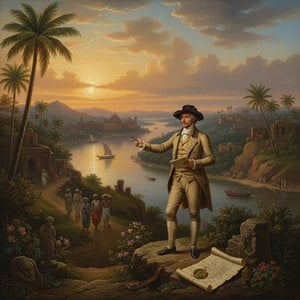
Miguel de Loarca: Pioneer of Philippine Exploration and Literary Legacy
Miguel de Loarca stands as a pivotal figure in the annals of Filipino history, embodying both daring exploration and intellectual curiosity. Born sometime around 1530 in Spain, he emerged from humble beginnings to become one of the earliest Spanish conquistadors tasked with establishing colonial dominion over the archipelago – a mission that would profoundly shape the nation’s trajectory.
Loarca's journey began with his enlistment in Legazpi’s expeditionary force in 1565, marking him as an integral participant in the audacious conquest of Cebu. Unlike many of his contemporaries driven solely by ambition and plunder, Loarca possessed a keen interest in documenting the natural world and its inhabitants – a characteristic that would define his subsequent endeavors.
His most enduring contribution to Philippine history lies in his magnum opus, “Treatise of the Philippines,” penned in 1572. This meticulously researched manuscript constitutes arguably the first comprehensive account of the Philippines by Europeans, offering invaluable insights into its geography, flora, fauna, and indigenous populations. Loarca’s detailed observations extended beyond mere description; he astutely analyzed the economic potential of the islands – advocating for the cultivation of indigo dye and silk production – demonstrating a visionary understanding of colonial development.
Beyond his scholarly pursuits, Loarca served as Governor General of Cebu from 1572 to 1576, overseeing the consolidation of Spanish authority and initiating crucial administrative reforms. He skillfully navigated complex political dynamics, fostering alliances with local chieftains while upholding Spanish law and order. His leadership ensured a stable foundation for further expansion into Mindanao.
Loarca’s legacy transcends his governmental role; he cemented Spain's presence in the Philippines through strategic land grants – notably awarding a substantial tract of land in Oton, Iloilo – which spurred agricultural innovation and contributed to the burgeoning colonial economy. His Treatise remains an unparalleled source for understanding the early Spanish colonial period, providing historians with invaluable data on the socio-economic conditions prevailing during those formative years.
- Early Life & Education: Loarca’s origins remain shrouded in obscurity, though he hailed from Andalusian nobility. His education likely encompassed humanist principles prevalent during the Renaissance, fostering a spirit of observation and intellectual inquiry.
- Military Service & Exploration: Loarca's involvement with Legazpi’s expedition solidified his reputation as a courageous adventurer. He participated in numerous expeditions aimed at securing Spanish dominion over Cebu and establishing settlements.
- Governor Generalship of Cebu (1572-1576): During his tenure, Loarca implemented reforms designed to bolster the colony's defenses and promote economic prosperity – a testament to his administrative acumen.
- “Treatise of the Philippines” - A Landmark Achievement: This seminal work stands as the first European account of the Philippines, showcasing Loarca’s meticulous research and astute analysis of Philippine resources.
Miguel de Loarca's contribution to Philippine history extends far beyond his military exploits; he bequeathed a literary masterpiece that continues to illuminate our understanding of the archipelago’s past. His unwavering dedication to documenting the natural world and advocating for sustainable economic development cemented his place as one of Spain’s most enlightened explorers and thinkers – an enduring symbol of intellectual curiosity amidst colonial ambition.