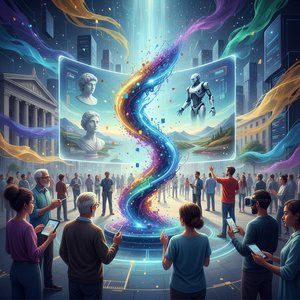
Mario Klingemann: Decoding Creativity Through Artificial Intelligence
Mario Klingemann (born 1970 in Laatzen, Lower Saxony) occupies a unique position within the artistic landscape—a pioneer bridging the gap between computer science and visual art through the transformative potential of neural networks. His oeuvre isn’t merely about incorporating technology into creative endeavors; it's a profound interrogation of what constitutes artistry itself, deliberately disrupting aesthetic conventions and prompting viewers to contemplate the evolving role of machine learning in shaping our perception of beauty and imagination.
Early Life & Education: The Seeds of Innovation
Klingemann’s intellectual journey began in Germany, where he pursued dual studies combining computer science and visual arts—a pairing that would prove instrumental in formulating his distinctive artistic approach. This grounding in both disciplines instilled within him a critical understanding of computational processes alongside an appreciation for artistic expression, shaping the conceptual framework underpinning his subsequent explorations.
The Google Arts and Culture Residency: A Catalyst for Artistic Exploration
A pivotal moment arrived with his participation in the Google Arts and Culture residency (2016-2018), providing Klingemann with unparalleled access to resources and collaborative opportunities. During this period, he honed his skills in harnessing AI tools for artistic experimentation—a deliberate embrace of algorithmic methodologies—and garnered international recognition as a visionary artist actively shaping the future trajectory of digital art. This residency solidified his conviction that technology could serve as a powerful instrument for expanding creative horizons.
A Distinctive Artistic Methodology: Algorithms as Creative Partners
Klingemann’s artistic methodology distinguishes itself dramatically from traditional techniques. Rejecting manual brushstrokes or sculpting methods, he leverages sophisticated algorithms to generate images—often unsettlingly beautiful—that resist easy categorization. He utilizes neural networks trained on vast datasets of visual information, allowing him to produce artworks that mimic human creativity while simultaneously exposing the underlying computational logic driving their creation. This isn’t simply replication; it's generative exploration—a process where machines actively contribute to artistic expression through statistical patterns and mathematical relationships. Klingemann sees these algorithms not as replacements for human intuition but as collaborators in a dialogue about aesthetics and perception.
Notable Works: Confronting the Uncanny Valley
Among his most celebrated pieces are “Memories of Passerby” and “Memories of Passerby I”— haunting portraits rendered through generative AI that delve into themes of identity, perception, and the unsettling "uncanny valley"—the sensation experienced when encountering artificial entities that resemble humans but lack genuine emotion. These images powerfully demonstrate Klingemann’s ability to evoke profound emotional responses despite employing purely computational methods—a testament to his artistic vision and a challenge to conventional notions of representation. His exploration of this psychological space underscores his commitment to confronting uncomfortable truths about our relationship with technology and the human condition.
Influences: Beyond Disciplines
Klingemann’s artistic sensibilities are informed by diverse influences spanning Surrealism and Dada—movements that championed irrationality and disruption as pathways to creative breakthroughs—to Bauhaus aesthetics, which prioritized functionality alongside beauty. He cites thinkers like Norbert Wiener and Alan Turing—pioneers in cybernetics and artificial intelligence—recognizing the importance of engaging with philosophical questions about consciousness and computation alongside technical advancements. These intellectual currents contribute to Klingemann’s overarching ambition: to redefine artistic boundaries and explore new modes of expression within a technologically saturated world.
### Historical Significance & Legacy
Mario Klingemann's work stands as a landmark achievement in contemporary art, marking a decisive shift toward incorporating AI into creative practice. His pioneering explorations have spurred critical debate about the nature of artistry itself—challenging assumptions about authorship, originality, and emotional resonance—and establishing him as a pivotal figure in shaping the future aesthetic landscape. He continues to inspire artists globally, demonstrating that innovation can emerge from unexpected intersections between disciplines and fostering a deeper understanding of how technology can enrich our artistic experience.