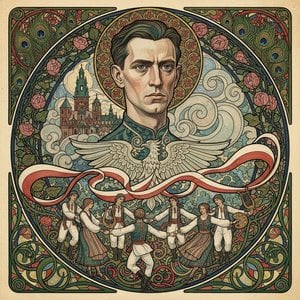
Leon Wyczółkowski (1852–1936): The Soul of Polish Realism
Leon Jan Wyczółkowski, born in Huta Miastowska near Garwolin in 1852, stands as one of Poland’s most revered painters and illustrators. His artistic journey commenced at Kraków University's Jan Matejko Academy of Fine Arts, where he honed his skills under the tutelage of luminaries like Antoni Kamieński, Rafał Hadziewicz, and Wojciech Gerson – figures who profoundly shaped the trajectory of Polish art. This formative period instilled in him a dedication to meticulous observation and an unwavering commitment to portraying the world with unflinching honesty.Early Artistic Influences & Style Development
Wyczółkowski’s artistic sensibilities were deeply rooted in Impressionism, though he skillfully blended this stylistic approach with the tenets of Realism. He absorbed inspiration from artists like Auguste Renoir and Claude Monet, recognizing the power of capturing fleeting moments and atmospheric conditions – elements that would become hallmarks of his distinctive oeuvre. However, unlike many Impressionists who prioritized subjective experience, Wyczółkowski steadfastly adhered to a rigorous pursuit of accuracy, meticulously documenting everyday life with remarkable detail. This commitment resulted in canvases brimming with palpable emotion conveyed through nuanced tonal gradations and masterful brushwork.The Young Poland Movement & Artistic Recognition
Wyczółkowski emerged as a pivotal voice within the Young Poland movement – a fervent surge of artistic innovation that championed national identity and challenged academic conventions during the late 19th century. He actively participated in debates surrounding artistic expression, advocating for a return to traditional Polish iconography while simultaneously embracing modern techniques. His unwavering belief in portraying the human condition with dignity and compassion solidified his reputation as a champion of humanist values within the artistic community.Notable Works & Collections
Wyczółkowski’s legacy rests upon an impressive body of work that continues to captivate audiences worldwide. Among his most celebrated paintings are “Zaporizhian Camp” by Józef Brandt, a monumental depiction of Ukrainian Cossack life imbued with dramatic intensity and psychological depth; and “Call to Arms” by Brandt, which powerfully conveys the spirit of patriotic fervor during Poland’s struggle for independence. These canvases exemplify Wyczółkowski's ability to distill complex narratives into visually arresting compositions—a testament to his artistic prowess. His paintings are proudly displayed in prestigious museums across Poland: The National Museum in Warsaw houses an extensive collection spanning centuries of Polish art history; Muzeum Narodowe Poznań showcases European masterpieces from the 15th to the 18th centuries; and Wyczółkowski’s works find their home in Muzeum Pomorskie (Danzig), dedicated to preserving Pomeranian heritage.A Lasting Impact on Polish Art History
Leon Wyczółkowski's contribution to Polish art history transcends mere stylistic innovation; he established a paradigm for Realism that prioritized truthful representation and emotional resonance. His unwavering dedication to capturing the essence of human experience—combined with his masterful command of technique—ensured his enduring influence on subsequent generations of artists. He remains an exemplar of artistic integrity and a symbol of Poland’s cultural heritage, guaranteeing his place among the nation's most revered figures.Fragen & Antworten
Welche Farben hat Leon Wyczółkowski am häufigsten verwendet?
Die Verwendung von Farbe in den Werken von Leon Wyczółkowski, die auf diese Website aufgeführt sind, kann auf der Farbgenom der Palette-Seite des Künstlers untersucht werden.
Wo sind die Kunstwerke von Leon Wyczółkowski nach Kunstrichtung gruppiert?
Die Werke von Leon Wyczółkowski können auf der Seite Alle Stilrichtungen nach Kunstströmungen durchsucht werden.
In welcher Stadt und in welchem Land wurde Leon Wyczółkowski geboren?
Leon Wyczółkowski wurde in Huta Miastowska, in Polen, geboren.
Woher kommt Leon Wyczółkowski?
Leon Wyczółkowski wurde in Polen geboren.
Gibt es eine Zeitachse der Werke von Leon Wyczółkowski?
Es gibt eine Zeitachse der Werke von Leon Wyczółkowski: Die Seite Zeitstrahl der Kunstwerke des Künstlers ordnet die Kunstwerke nach ihrem Entstehungsdatum.
Wo und in welchem Jahr wurde Leon Wyczółkowski geboren?
Leon Wyczółkowski wurde 1852 in Huta Miastowska geboren.
Wo sind die Kunstwerke von Leon Wyczółkowski nach Schlagworten gruppiert?
Die Werke von Leon Wyczółkowski können über die Nach Schlagworten-Seite nach Schlagworten durchsucht werden. Jedes Schlagwort gruppiert die entsprechenden Kunstwerke.