A Quiet Master of Intimacy: The World of Louis-Marie Lemaire
Louis-Marie Lemaire, a name perhaps less immediately recognizable than some of his contemporaries, nevertheless occupies a significant and deeply charming niche within the landscape of 19th-century art. Born in Belgium in 1772, Lemaire dedicated himself to the exquisite detail and refined sensibility of miniature painting – an art form that flourished during this period as a means of capturing not just likenesses, but also atmosphere and emotion on an incredibly intimate scale. While biographical details remain somewhat sparse, the surviving body of his work speaks volumes about a life devoted to observation, technical mastery, and a gentle appreciation for the beauty found in everyday scenes and aristocratic portraiture. He wasn’t painting grand historical narratives or revolutionary statements; instead, Lemaire focused on the quiet poetry of domestic life, rural tranquility, and the dignified elegance of courtly society.
Early Life and Artistic Formation
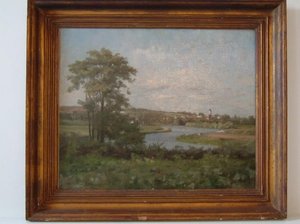
The early years of Lemaire's artistic journey are not extensively documented, but it is known he received training in Brussels, a city then becoming an important center for Neoclassical art. This influence is subtly present in his work – a clarity of form, balanced compositions, and a restrained palette that avoids excessive drama. However, Lemaire quickly developed a style distinctly his own, moving away from the strict formality of Neoclassicism towards a more Romantic sensibility. He became particularly adept at watercolor techniques, allowing him to achieve luminous effects and delicate gradations of tone essential for miniature painting. His early works often depict small landscapes, showcasing a keen eye for light and shadow and an ability to capture the subtle nuances of the Belgian countryside. It’s believed he initially worked under the guidance of established miniaturists in Brussels, honing his skills in portraiture before establishing himself as an independent artist.
A Career Defined by Commissions and Courtly Favor
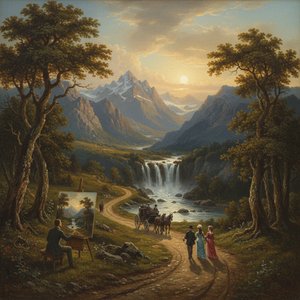
Lemaire's career blossomed through a combination of private commissions and patronage from aristocratic circles. He became highly sought after for his portraits, particularly those commissioned by members of the Belgian court and nobility. These weren’t simply formal representations; Lemaire imbued his sitters with personality and grace, capturing not just their physical appearance but also something of their inner character. His skill in portraying fabrics – silks, velvets, lace – was exceptional, adding to the sense of luxury and refinement that characterized his courtly commissions. Beyond portraiture, he continued to paint idyllic landscapes, often featuring figures engaged in leisurely activities – a picnic by a river, a stroll through a park, or simply enjoying the tranquility of nature. These scenes reflect a growing Romantic interest in rural life and a desire to escape the complexities of urban society. He also worked under the name Louis-Marie Autissier during parts of his career.
Technique and Artistic Style
Lemaire’s mastery lay in his ability to create incredibly detailed and lifelike miniatures using watercolor on ivory. The small scale demanded exceptional precision, and he employed a meticulous layering technique to build up tone and texture. He was known for his subtle use of color, creating harmonious palettes that evoke a sense of calm and serenity. His brushwork is remarkably delicate, almost invisible at times, allowing the colors to blend seamlessly together.
The luminosity of his watercolors is particularly striking – he achieved this through careful glazing techniques and a masterful understanding of light and shadow. Unlike some miniaturists who focused solely on likeness, Lemaire paid close attention to capturing the atmosphere of a scene, creating a sense of depth and realism that belies the small size of his works.
His landscapes are particularly notable for their atmospheric perspective, conveying a feeling of spaciousness and tranquility.
Legacy and Historical Significance
While Lemaire may not be a household name, his work represents an important strand within 19th-century art. He exemplifies the enduring appeal of miniature painting as a means of capturing intimacy and emotion. His landscapes offer a glimpse into the beauty of the Belgian countryside during a period of significant social and political change.
- His portraits provide valuable insights into the lives and customs of the Belgian aristocracy.
- He bridged the gap between Neoclassical formality and Romantic sensibility, developing a style that was both refined and emotionally engaging.
- Lemaire’s meticulous technique and subtle use of color continue to inspire artists today.
His work serves as a reminder that beauty can be found in the small details – in the gentle light of a summer afternoon, the elegant pose of a courtly sitter, or the quiet tranquility of a rural scene. He remains a testament to the power of observation and the enduring appeal of artistic skill dedicated to capturing the essence of life’s quieter moments.