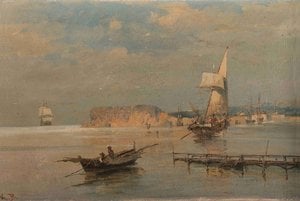
Der Barde der griechischen See
Konstantinos Volanakis steht als monumentale Gestalt in den Annalen der hellenischen Kunst; ein Maler, dessen Pinsel die eigentliche Seele der Ägäis einfing. In liebevoller Weise bekannt als der „Vater der griechischen Meeresmalerei“, war sein Leben eine Reise, die das Ebbe und Flut der Gezeiten widerspiegelung, die er so hingebungsvoll darstellte. Geboren 1837 in Heraklion, Kreta, entstammte Volanakis bescheidenen Verhältnissen nahe Rethymno – einer Landschaft, die von der rauen Schönheit seiner Heimat geprägt war. Seine frühen Jahre waren von Bewegung und Übergängen gezeichnet, was ihn schließlich auf die Insel Syros führte, wo er 1856 seine Grundausbildung inmitten des geschäftigen Seehandels abschloss, der später zum zentralen Protagonisten seines Lebenswerks werden sollte.
Die Flugbahn seiner Karriere wurde nicht durch eine formale Berufung verändert, sondern durch einen glücklichen Umweg in den Handel. Als er nach Triest zog, um als Buchhalter für eine Familie griechischer Kaufleute zu arbeiten, fand sich Volanakis von salziger Luft und den Silhouetten gewaltiger Schiffe umgeben. In den Rändern seiner akribischen Kontobücher begann seine wahre Leidenschaft an die Oberfläche zu treten; statt bloßer Zahlen und Summen waren die Seiten nun übersät mit exquisiten Skizzen von Schiffen und Häfen. Dieses latente Talent blieb bei seinen Gönnern nicht unbemerkt, die einen tiefen künstlerischen Funken erkannten und seine Reise zur prestigeträchtigen Akademie der Bildenden Künste in München ermöglichten. Unter der Anleitung des renommierten Karl von Piloty schloss sich Volanakis einer illustren Gruppe griechischer Studenten an und verfeinerte eine Technik, die schließlich die Lücke zwischen klassischer Präzision und atmosphärischer Emotion überbrücken sollte.
Meisterschaft des Lichts und maritime Erhabenheit
Obwohl seine formale Ausbildung ihn zunächst in Richtung der Porträtmalerei drängte – da die Landschaftsmalerei damals von vielen Akademikern als ein Genre im Niedergang angesehen wurde –, blieb Volanakis unerschütterlich dem Meer verbunden. Seine Entwicklung als Künstler war geprägt von einer beispiellosen Fähigkeit, das Gewicht des Wassers, die Lichtdurchlässigkeit der Wellen und das komplexe Takelwerk der Segelschiffe darzustellen. Er besaß einen scharfen und liebevollen Blick für die Natur und verwandelte maritime Szenen in tiefgründige Studien der Atmosphäre. Ob er nun die mondbeschienene Ruhe eines Hafens oder die dramatische Spannung eines sturmgepeitschten Schiffes einfing, sein Werk widerhallt von einer tiefen, rhythmischen Vitalität.
Seine Errungenschaften wurden durch bedeutende historische Meilensteine markiert, die seinen Status von einem talentierten Studenten zu einem international anerkannten Meister erhoben. Ein solcher Moment ereignete sich 1869 nach der Schlacht von Lissa, als Volanakis einen Sieg in einem prestigeträchtigen Zeichnungswettbewerb errang, der von Kaiser Franz Joseph eingesetzt worden war. Der Preis – eine beträchtliche Summe in Goldfloren und drei Jahre kostenlose Reise an Bord österreichischer Kriegsschiffe – bot ihm einen unvergleichlichen Aussichtspunkt, um die Erhabenheit des Marinelebens aus erster Hand zu beobachten. Diese Zeit der Erkundung erlaubte es ihm, seine Darstellungen von Dampf und Segel zu perfektionieren und seinen Ruf als führender Marinemaler zu festigen.
Vermächtnis und historische Bedeutung
Die historische Bedeutung von Volanakis reicht weit über die ästhetische Schönheit seiner Leinwände hinaus. Sein Werk dient als visuelle Chronik einer transformativen Ära der griechischen Geschichte und hält die maritime Essenz der griechischen Konsolidierung nach der Unabhängigkeit fest. Einer seiner tiefgreifendsten Beiträge zur nationalen Identität ist sein Meisterwerk, die „Seeschlacht von Salamis“. Diese epische Darstellung des antiken Zusammenstoßes zwischen den griechischen Stadtstaaten und dem Perserreich wird so verehrt, dass sie der griechischen Marine gehört und traditionell im Büro des griechischen Premierminister hängt.
Trotz der Tatsache, dass die späteren Jahre seines Lebens von persönlichen Entbehrungen und wirtschaftlicher Not geprägt waren, bleibt sein Einfluss auf den Verlauf der griechischen Kunst unauslöschlich. Er kehrte 1883 dauerhaft nach Griechenland zurück und ließ sich in Piräus nieder, wo er bis zum Nachlassen seiner Gesundheit an der Athenischen Akademie der Bildenden Künste lehrte. Volanakis hinterließ ein Vermächtnis, das über eine einfache maritime Dokumentation hinausgeht; er schenkte der Welt eine poetische Interpretation des Meeres und stellte sicher, dass der Geist der Ägäis durch das feine Zusammenspiel von Licht, Schatten und Salz für immer bewahrt bleibt.
Fragen & Antworten
Kann ich ein virtuelles Museum mit den Werken von Konstantinos Volanakis besuchen?
Ein virtueller Besuch ist möglich: Die Seite 3D-Museum von Konstantinos Volanakis präsentiert die Werke des Künstlers in einer dreidimensionalen Galerie.
Welche Farben hat Konstantinos Volanakis am häufigsten verwendet?
Die Verwendung von Farbe in den Werken von Konstantinos Volanakis, die auf diese Website aufgeführt sind, kann auf der Farbgenom der Palette-Seite des Künstlers untersucht werden.
Wo und in welchem Jahr wurde Konstantinos Volanakis geboren?
Konstantinos Volanakis wurde 1837 in Ηρακλείον geboren.