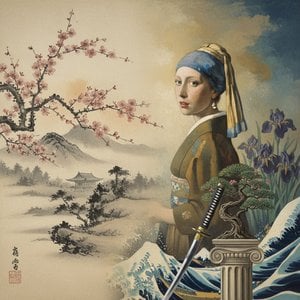
Kishi Ganryo (岸良, 岸), born in Kyoto around 1798, emerged from a lineage steeped in artistic tradition. His father, Kishi Ganku (岸駒), was himself a prominent retainer of Prince Arisugawa Yoshimune, establishing a connection to the imperial court that would profoundly shape Ganryo’s career trajectory. This familial influence instilled within him an appreciation for refined aesthetics and a dedication to mastering the techniques of Japanese painting—specifically, the Kano School tradition. Recognizing his talent early on, Ganku entrusted Ganryo's education to renowned Kano painters, ensuring he received comprehensive instruction in composition, brushwork, pigment preparation, and stylistic considerations crucial to achieving excellence within this influential artistic movement.The Kano School, founded by Kano Eitoku (1543-1615), championed a style characterized by meticulous detail and harmonious balance—a legacy Ganryo diligently absorbed.
Life and Artistic Training
Ganryo’s formative years were marked by an immersion in the artistic traditions of Kyoto, where he benefited from the patronage of his father and access to the finest instructors. His upbringing instilled within him a deep understanding of Japanese cultural values and fostered a lifelong commitment to artistic excellence. Like his father, Ganryo served as a retainer for Prince Arisugawa Yoshimune—a position that afforded him considerable prestige and provided invaluable opportunities for scholarly pursuits alongside artistic endeavors. Crucially, he received instruction from masters such as Kano Eitoku and Maruyama Okyo, guaranteeing he mastered the foundational principles of Kano School painting—a style renowned for its serene beauty and masterful use of tonal gradation. This rigorous training ensured Ganryo possessed the technical skills necessary to excel in his chosen profession.
Service to the Imperial Court and Artistic Development
Ganryo’s career progressed steadily through the ranks of the Tokugawa shogunate, securing him positions within the imperial administration and fostering connections with influential patrons—a circumstance that further enriched his artistic vision. He actively engaged in court affairs, gaining firsthand experience of the complexities of Edo-period governance while simultaneously honing his artistic sensibilities. Recognizing the limitations of solely adhering to the Kano School’s formalism, Ganryo embraced the expressive dynamism of *nanga* painting—a genre blending landscape painting with calligraphy and poetry. This stylistic fusion reflected a broader intellectual trend toward reconciling tradition with innovation—a hallmark of Ganryo's artistic approach. He collaborated closely with Goshun and Yokoyama Kazan, absorbing their techniques and expanding his repertoire of artistic styles.
Notable Works and Artistic Style
Ganryo’s artistic output is characterized by its remarkable sensitivity to natural beauty—particularly mountain landscapes rendered with subtle tonal variations that convey a profound sense of atmosphere. His paintings exemplify the Kano School's commitment to meticulous detail and harmonious balance, yet they also incorporate elements characteristic of *nanga*, demonstrating Ganryo’s willingness to experiment with new expressive techniques. Among his most celebrated works is “Watermill in the Mountains,” which exemplifies his ability to capture the essence of nature with understated elegance—a testament to his mastery of brushwork and pigment preparation. Furthermore, he produced rare floral scrolls featuring exquisitely rendered blossoms and foliage—reflecting a deep appreciation for botanical illustration alongside compositional considerations. His distinctive style—marked by layered brushstrokes and a masterful command of tonal gradation—continues to inspire admiration for its beauty and technical virtuosity.
Legacy and Historical Significance
Kishi Ganryo stands as a pivotal figure in the history of Edo-period Japanese painting, representing the culmination of Kano School traditions while simultaneously embracing the expressive qualities of *nanga*. His works serve as testament to the artistic dynamism of his era—a period marked by both cultural conservatism and intellectual ferment. As a retainer of Prince Arisugawa Yoshimune and a respected artist within Kyoto’s artistic milieu, Ganryo contributed significantly to the preservation and advancement of Japanese painting traditions.His influence extended beyond his own lifetime, shaping the stylistic sensibilities of subsequent generations of Kishi painters—including Gantai, Ganryo, Gankei, Gansei—solidifying his place as one of Japan’s most accomplished landscape artists. His surviving paintings continue to inspire admiration for their beauty and technical virtuosity, offering invaluable insights into the artistic culture of 18th-century Kyoto.
Vom WahooArt.com Redaktionsteam
Kunst-Quiz
Jede Frage hat nur eine richtige Antwort.
Frage 1:
Wie war Kishi Ganryos Rolle während seines Lebens?
Frage 2:
Kishi Ganryos künstlerischer Stil ist durch folgende Eigenschaften gekennzeichnet:
Frage 3:
Welche Schule der japanischen Malerei studierte Kishi Ganryo zunächst?
Frage 4:
Für was ist Kishi Ganryo bekannt?
Frage 5:
Wer war Kishi Ganryos Vater, der ihn maßgeblich beeinflusste?
Explore the profound beauty of Japanese landscape painting. From Hokusai's iconic vistas to Zen-inspired compositions, discover the spiritual depth and historical mastery of Ukiyo-e art in this expert cultural retrospective.
Explore the profound influence of Japanese artistry on global masterpieces. From Ukiyo-e prints to Zen aesthetics, discover how Eastern elegance transformed Western art history in this deep cultural reflection for fine art enthusiasts and collectors.
Explore the ephemeral beauty of Japanese Ukiyo-e art. From the dynamic warriors of Kuniyoshi to serene landscapes, discover the profound history, masterful techniques, and global influence of these iconic woodblock prints in our deep cultural retrospective.
WConciergeOnline · antwortet innerhalb einer Minute
Hallo! Ich kann Ihnen dabei helfen, ein Kunstwerk auszuwählen, eine Bestellung zu verfolgen oder Fragen zur Garantie zu beantworten. Wie kann ich Ihnen heute behilflich sein?