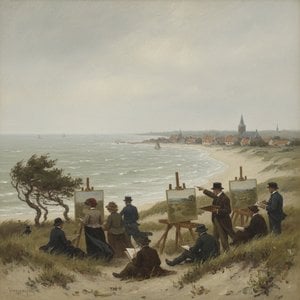
Kano Shōei: Bridging Tradition and Innovation in Japanese Landscape Painting
Kano Shōei (1519 – 1592) stands as a pivotal figure within the Kanō School of painting, arguably its most influential successor. Born in Kyoto during the Muromachi period, he emerged from the lineage of Kano Motonobu, establishing himself as a master craftsman and artist who profoundly shaped Japanese visual culture for decades to come. His artistic legacy extends beyond mere aesthetic beauty; it embodies a synthesis of Chinese artistic principles with distinctly Japanese sensibilities—a hallmark of Kanō School’s evolution.
Early Life & Training: Shōei's formative years were spent under the tutelage of his father, Kano Motonobu, who had already begun to forge the school’s distinctive style. This early exposure instilled in him a deep understanding of Chinese landscape painting techniques and compositional strategies, particularly those championed by artists like Sesshu Toyokuni—influences that would permeate Shōei's oeuvre throughout his career. The meticulous observation of nature and the careful rendering of detail were hallmarks of Motonobu’s approach, values that Shōei diligently absorbed and subsequently perfected.
Marriage & Patronage: A strategic marriage to the daughter of Tosā Mitsunobu solidified Shōei’s position within Kyoto’s artistic elite and secured him access to influential patrons, notably Ōuchi Yoshimune. This patronage enabled him to undertake ambitious projects—most notably the decoration of castles—further propelling the Kanō School's prestige and disseminating its stylistic innovations across Japan. The Ōuchi clan recognized Shōei’s talent and commissioned numerous monumental screens depicting landscapes and mythological scenes, cementing his reputation as one of Kyoto’s foremost artists.
Style & Technique: Shōei’s artistic style is characterized by a masterful blend of meticulous detail and bold color palettes. Unlike his father, who favored subtle tonal gradations, Shōei embraced vibrant hues—particularly crimson and gold—creating luminous landscapes that captivated viewers. His technique involved layering thin washes of ink over meticulously rendered brushstrokes, resulting in surfaces imbued with depth and texture. This approach aligns closely with the stylistic developments initiated by Kano Motonobu but distinguishes itself through a heightened expressive quality – Shōei’s bold outlines and assertive color choices departed from traditional conventions, injecting dynamism into his compositions. He skillfully utilized glazing techniques to achieve remarkable luminosity and tonal variation, pushing the boundaries of Kanō School's aesthetic standards.
Notable Works & Legacy: Shōei produced an astonishing array of paintings that continue to inspire admiration for their beauty and technical virtuosity. Among his most celebrated achievements is the monumental screen depicting a snowy landscape with cranes in Shinju-an, a subtemple of Daitoku-ji—a masterpiece recognized as a national treasure due to its masterful execution and symbolic resonance. This artwork exemplifies Shōei’s dedication to capturing the sublime grandeur of nature while simultaneously conveying profound spiritual contemplation. Furthermore, his depiction of lotus blossoms in monochrome ink, housed in the Kyushu National Museum, stands as testament to his mastery of tonal gradation and compositional balance—a piece that embodies the essence of Zen aesthetics. Kano Shōei's influence extended far beyond his lifetime, shaping the visual landscape of Japan for centuries to come and establishing a precedent for subsequent generations of Japanese painters. He remains an enduring symbol of artistic excellence and cultural heritage.
Sources: “The Kano School of Painting,” Metropolitan Museum of Art, Web. 2018 “Hano Shoei,” The MFA Handbook: A Guide to the Collections of the Museum of Fine Art, Boston, p. 138
Vom WahooArt.com Redaktionsteam
Kunst-Quiz
Jede Frage hat nur eine richtige Antwort.
Frage 1:
Wer war Kano Shōei’s Vater bekannt für?
Frage 2:
Welche Schule der Malerei gehörte Kano Shōei an?
Frage 3:
Was für eine Art Gemälde waren Kano Shōei besonders bekannt für?
Frage 4:
Wer war Kano Shōei verheiratet?
Frage 5:
Welches beeindruckende Gemälde von Kano Shōei wird als nationale Schatz von Japan angesehen?
Explore the profound beauty of Japanese Ukiyo-e art. Discover the legacy of Hokusai and the Utagawa school through an expert exploration of Edo-period aesthetics, seasonal motifs, and the enduring global influence of Japan's 'Floating World' on fine art history.
Explore the ephemeral beauty of Japanese Ukiyo-e art. From the dynamic warriors of Kuniyoshi to serene landscapes, discover the profound history, masterful techniques, and global influence of these iconic woodblock prints in our deep cultural retrospective.
Explore the ethereal beauty of the Hague School art movement. Discover how masters like Jan Weissenbruch captured the atmospheric grey light of the Dutch landscape through unparalleled technique and emotive, misty compositions.
WConciergeOnline · antwortet innerhalb einer Minute
Hallo! Ich kann Ihnen dabei helfen, ein Kunstwerk auszuwählen, eine Bestellung zu verfolgen oder Fragen zur Garantie zu beantworten. Wie kann ich Ihnen heute behilflich sein?