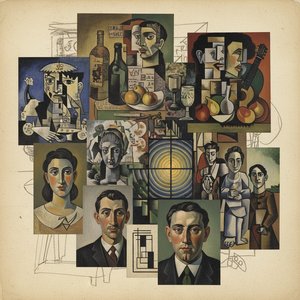
John Golding: Bridging Cubism and Scottish Landscape
John Golding (10 September 1929 – 9 April 2012) stands as a singular figure in the annals of British art history—a polymath whose intellectual rigor complemented an extraordinary artistic talent. Born in Hastings, England, he embarked on a remarkable journey that intertwined his formative years in Mexico with a distinguished career as painter, scholar, and curator, establishing him as one of the foremost voices interpreting the complexities of 20th-century visual culture. His legacy resides not merely in his captivating canvases but also in his seminal contribution to art criticism, particularly his groundbreaking treatise on Cubism: A History and Analysis (1907–1914), which remains a cornerstone of understanding this revolutionary artistic movement.
Early Life & Mexican Roots
Golding’s upbringing was profoundly shaped by his mother's heritage—a lineage rooted in Mexico—providing him with an unparalleled perspective on cultural exchange and artistic traditions. This dual influence instilled within him a lifelong fascination for both European intellectual currents and the vibrant landscapes of Latin America, informing his artistic sensibilities and scholarly pursuits. From a young age, he demonstrated an exceptional aptitude for languages and humanities, nurturing a deep appreciation for classical literature and philosophical inquiry—qualities that would prove invaluable to his subsequent academic endeavors. The formative experiences gained during his travels in Mexico instilled within him a sensitivity to cultural diversity and a profound understanding of artistic expression across geographical boundaries.
Academic Foundations & Artistic Exploration
He pursued formal education at Oxford University, earning degrees in Classics and Philosophy, equipping him with analytical skills that would prove invaluable to his subsequent endeavors as an art historian. Simultaneously, he honed his artistic craft through intensive studio practice, experimenting with diverse mediums and styles—primarily oil painting—resulting in a portfolio characterized by sensitivity to tonal nuances and evocative depictions of the Scottish Highlands. His meticulous attention to detail—a hallmark of his artistic style—reflected his commitment to scholarly rigor and his belief that observation was paramount to creative expression. The influence of Cézanne’s geometric simplification and Picasso’s fractured perspectives profoundly shaped his artistic vision, fostering a desire to capture the essence of visual experience with uncompromising precision.
Cubism: A Paradigm Shift
Golding’s magnum opus, Cubism: A History and Analysis (1907–1914), irrevocably altered the trajectory of art scholarship. Departing from prevailing orthodoxies, he championed a nuanced interpretation of Picasso and Braque's pioneering explorations into fractured perspectives and geometric abstraction. He argued that analyzing a painting’s visual elements—such as color, line, and texture—yielded crucial insights into its expressive power. His meticulous research combined with astute stylistic discernment cemented his reputation as an intellectual giant who illuminated the conceptual underpinnings of Cubism’s transformative impact on Western art. Golding meticulously documented the evolution of Cubist ideas, tracing their roots in Cézanne's radical simplification of form and examining the debates surrounding Picasso and Braque’s innovative techniques—demonstrating a masterful command of both artistic history and theoretical argumentation.
Notable Paintings & Artistic Style
His artistic output encompassed a diverse range of subjects—from monumental landscapes capturing the grandeur of Scotland to intimate portraits reflecting human emotion—demonstrating his versatility as an artist. His distinctive style was marked by a deliberate restraint in color palettes, prioritizing tonal harmonies and subtle gradations that conveyed atmospheric depth and psychological resonance. Works such as “Boat Race” exemplify his masterful command of color and composition, conveying a profound appreciation for the natural world. Golding’s canvases are characterized by a remarkable stillness—a contemplative quality that invites viewers to engage with the depicted scene on an emotional level. He skillfully employed glazing techniques—allowing layers of pigment to blend seamlessly together—creating luminous surfaces that captured the subtleties of light and shadow.
Legacy & Recognition
Golding’s influence extended beyond the confines of academia; he served as Director of Paintings Conservation at Dulwich Picture Gallery for many years, safeguarding artistic treasures and fostering dialogue between art history and visual culture. He was awarded a Fellowship by the British Academy in 1986, recognizing his scholarly achievements and cementing his position as one of Britain’s most distinguished humanist thinkers. His unwavering dedication to preserving cultural heritage—coupled with his intellectual curiosity—established him as an exemplar of artistic scholarship and humanist engagement. Golding's contribution to art criticism continues to inspire scholars today, encouraging them to pursue innovative interpretations of artistic history and to grapple critically with the complexities of visual culture.