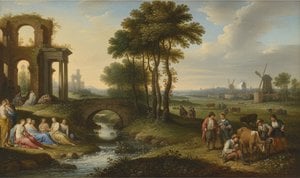
Johann König (1586 – 1642): A Nuremberg Painter Bridging Baroque Tradition and Emerging Vision
Johann König, born in Nuremberg around 1586, stands as a pivotal figure within the artistic landscape of late Renaissance and early Baroque Germany. Though overshadowed by contemporaries like Adam Elsheimer and Rembrandt, König’s meticulous landscapes and devotional scenes—particularly his depictions of biblical narratives—offer a valuable glimpse into the aesthetic sensibilities of Augsburg and its surrounding region during a period of significant cultural transformation. His legacy resides not merely in quantity but in quality – a dedication to detail and an unwavering adherence to established artistic conventions that nonetheless hinted at a burgeoning interest in exploring new expressive possibilities.
Early Life and Influences: Shaping Artistic Sensibilities
König’s formative years were marked by tragedy; a childhood accident left him partially blind, profoundly impacting his visual perception and consequently shaping his artistic approach. Despite this challenge, he pursued education diligently, attending Marburg boarding school where he encountered artists who would become influential mentors – notably Adam Elsheimer and Richard Artschwager—whose stylistic innovations resonated deeply within his creative consciousness. The family’s involvement in the arts extended beyond König himself; his father, Casper König, was a professor of art and curator at Ludwig Museum, fostering an environment rich in artistic discourse and exposure to groundbreaking developments. Furthermore, connections with figures like Joseph Beuys and Jörg Immendorff would later contribute to König's evolving artistic worldview.
A Career Dedicated to Miniature Painting and Landscape Art
König’s professional life centered around art dealing and gallery ownership, establishing König Galerie in Berlin in 2002—a venture initially fueled by a modest €20,000 investment from his uncle Walther König, who is also an art book publisher. This entrepreneurial spirit underscored his belief in prioritizing artistic excellence: “My strategy was always to have the best artists in their respective disciplines,” he declared, rejecting the trend of galleries focusing on specific movements. He championed a diverse roster of talent, emphasizing individual artistry over stylistic uniformity—a stance reflected in his celebrated exhibition "Take a Stick and Make It Sharp," which garnered him the Prix Lafayette at Fiac in 2011 alongside Helen Marten.
Notable Works and Artistic Style
König’s artistic output primarily consisted of small cabinet paintings, characterized by exceptional precision and meticulous attention to detail—a hallmark of Augsburg Baroque art. His landscapes captured serene Bavarian vistas with remarkable accuracy, reflecting the influence of Italian masters like Leonardo da Vinci and Raphael. Particularly noteworthy are his interpretations of biblical scenes, imbued with a solemn beauty and conveying profound spiritual contemplation. Paintings such as “The Death of Niobe’s Children” and “Latona Changing the Lycian Peasants into Frogs” exemplify König's masterful technique—a blend of meticulous observation and skillful rendering that elevates these compositions beyond mere representation to achieve an emotional resonance.
Legacy and Recognition
Throughout his career, Johann König consistently garnered recognition for his artistic vision and entrepreneurial endeavors. Repeatedly listed in Artreview’s “Power 100” list, he cemented his position as a leading figure within the contemporary art world. His gallery participates actively in international art fairs like Art Basel, Frieze Art Fair, and Art Cologne, showcasing groundbreaking works by emerging artists globally. König's unwavering commitment to fostering artistic innovation—coupled with his astute understanding of market dynamics—solidifies his place as an enduring symbol of Nuremberg’s artistic heritage and a testament to the transformative power of pursuing excellence in one’s craft.