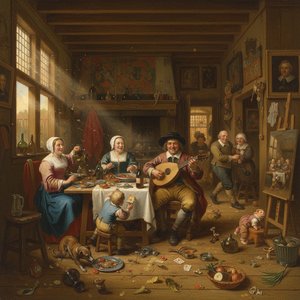
Jan II Kobell: A Master of Dutch Landscape and Animal Art
Jan II Kobell (1778-1814) stands as a prominent figure in the landscape painting tradition of early 19th century Germany, particularly recognized for his meticulous depictions of cattle scenes and serene river vistas. Influenced profoundly by the artistic legacy of Claude Lorrain—a cornerstone of Baroque idealism—Kobell’s oeuvre embodies a harmonious blend of Dutch realism and Romantic sensibility. His work reflects not only technical prowess but also an astute understanding of visual storytelling and emotional resonance, securing him a lasting place within the canon of European art history.
### Early Life and Artistic Formation
Born in Mannheim, Kobell descended from a family steeped in artistic heritage—his father, Ferdinand Kobell, himself a landscape painter who championed Lorrain’s stylistic principles—established a lineage dedicated to capturing the beauty of nature. Initial instruction commenced under his father's tutelage alongside that of Franz Kobell, fostering an early appreciation for tonal harmony and atmospheric perspective. Further refinement occurred at the Mannheim Kunstakademie, where he honed his skills under Franz Anton von Leydendorf and Egid Verhelst—masters of engraving who instilled in him a disciplined approach to printmaking and a meticulous attention to detail. This formative period exposed Kobell to the artistic currents circulating throughout Europe, notably the grandeur of Lorrain’s compositions and the expressive dynamism of English Romanticism. He demonstrated an exceptional talent for drawing from a young age, meticulously studying anatomical sketches and mastering perspective techniques—skills that would prove invaluable in his subsequent artistic endeavors.
### Artistic Style and Technique: Echoes of Lorrain and Dutch Masters
Kobell's distinctive style—characterized by luminous color palettes, subtle gradations of tone, and an unwavering commitment to realism—bears unmistakable marks of Lorrain’s influence. Like Lorrain, Kobell prioritized idealized landscapes imbued with spiritual grandeur, employing techniques designed to evoke contemplation and admiration for the sublime. However, Kobell’s artistic vision wasn't solely rooted in Baroque aesthetics; he actively engaged with the stylistic innovations emerging from Holland during his time—particularly those championed by artists like Jacob Ruysdael and Willem van Roestraten. He meticulously copied works from these masters, absorbing their compositional strategies and mastering their nuanced rendering of light and shadow. This dual inspiration resulted in paintings that possess both a serene beauty reminiscent of Lorrain’s landscapes and the palpable energy characteristic of Dutch genre scenes. Kobell's masterful use of glazing—a technique perfected by Rembrandt and his successors—created surfaces rich in texture and luminosity, capturing the subtle nuances of atmospheric conditions with remarkable accuracy. He achieved an unparalleled level of anatomical precision when depicting cattle—a testament to his dedication to scientific observation combined with artistic sensitivity.
### Notable Works and Recognition
Kobell gained considerable acclaim for his depictions of cattle herds—particularly those executed near Mannheim—where he achieved a level of anatomical precision rarely matched by his contemporaries. These paintings exemplify Kobell’s dedication to scientific observation combined with artistic sensibility, demonstrating an understanding of animal behavior and physiology that surpassed conventional representations. Furthermore, Kobell's etchings after Willem van Roestraten and other Dutch masters showcased his exceptional engraving skills—a craft he pursued with unwavering diligence at the Kunstakademie München from 1808, shaping generations of aspiring artists and disseminating Lorrain’s influence throughout German art education. His battle scenes—such as “The Third Day of the Battle of Hanau”—were distinguished by their dramatic compositions, detailed depictions of soldiers’ uniforms, and portraits of prominent figures—reflecting Kobell's engagement with contemporary history and his ability to convey emotion through visual imagery. The Neue Pinakothek in Munich houses a celebrated rendition of "Gaismasalmreiter am Tegernsee," cementing Kobell's reputation as one of the foremost landscape painters of Bavaria.
### Legacy and Influence
Jan II Kobell’s artistic legacy extends beyond his individual paintings—he served as professor at the Kunstakademie München from 1808, shaping generations of aspiring artists and disseminating Lorrain’s influence throughout German art education. His unwavering devotion to meticulous observation and masterful technique continues to inspire admiration among scholars and collectors alike. Kobell's work stands as a testament to the enduring power of artistic tradition—a harmonious synthesis of Baroque idealism and Dutch realism that secures him a place as a pivotal figure in European landscape painting history. He is remembered not only for his stunning visual achievements but also for his role in fostering a new generation of artists committed to upholding the highest standards of artistic excellence.