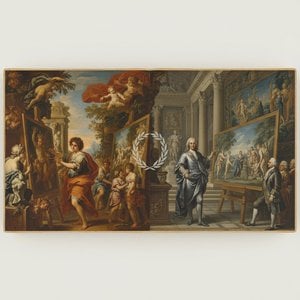
Jacques de Létin (1597 - 1661): Ein vergessener Meister der barocken Porträtmalerei
Jacques de Létin, auch bekannt als Jacques Ninet de Lestin oder Jacques de L'Estin (1597 Troyes – Oktober 1661 Troyes), bleibt eine rätselhafte und schwer fassbare Gestalt in den Annalen der französischen Kunstgeschichte. Trotz eines beachtlichen Schaffens – primär religiöse Gemälde und Porträts – geriet er nach seinem Tod in Vergessenheit, was maßgeblich auf die zerstörerischen Kräfte der Französischen Revolution und der darauffolgenden Konflikte zurückzuführen ist. Doch die moderne Forschung hat begonnen, sein Leben und sein künstlerisches Vermächtnis neu zu beleuchten und ihn als bedeutenden Vertreter der Barockmalerei sowie als Schüler des dramatischen Stils Caravaggios zu rehabilitieren.
- Frühes Leben & Ausbildung: Geboren in eine bescheidene Familie in Troyes, erhielt Jacques de Létin eine Ausbildung, die sowohl das Goldschmiedehandwerk als auch die Malerei umfasste. Sein Vater, Jehan, betrieb das Gasthaus „L'Image de Saint-Christophe“, was dem jungen Létin frühen Zugang zum künstlerischen Milieu seiner Heimatstadt ermöglichte. Entscheidend war seine Lehre bei Edme Doué (?-1626), einem Künstler, der 1613 Létins Schwester Simonne geheiratet hatte. Doués Einfluss prägte in Létin eine tiefe Faszination für Caravaggios expressive Technik und theatralische Kompositionen – ein stilistisches Merkmal, das sein gesamtes Werk durchdringen sollte.
- Rom & künstlerische Einflüsse: Im Jahr 1622 brach Létin zu einer transformativen Reise nach Rom auf, wo er gemeinsam mit Charles Mellin und Jacques Sarrazin lebte. Diese Zeit erwies sich als entscheidend für seine künstlerische Sensibilität; er nahm aktiv am pulsierenden römischen Kunstleben teil und knüpfte Freundschaften mit bedeutenden Künstlern wie Simon Vouet – eine Verbindung, die Vouets Ruf als Mentor von Létin festigte.
- Rückkehr nach Troyes & Mäzenatentum: Nach seiner Rückkehr nach Troyes im Jahr 1626 gründete Létin ein Atelier und heiratete kurz darauf. Seine Werkstatt florierte unter der Schirmherrschaft einflussreicher Persönlichkeiten, wobei er zahlreiche Porträts und religiöse Gemälde schuf, die seine technische Meisterschaft und stilistische Innovation demonstrierten. Besonders hervorzuheben ist sein monumentaler Auftrag für Notre-Dame de Paris – die Darstellung „Paulus predigt auf dem Areopag“ –, ein Werk, das während des Deutsch-Französischen Krieges tragischerweise zerstört wurde.
- Reifer Stil & Vermächtnis: Nach 1645 ließ sich Létin dauerhaft in Troyes nieder und führte ein ruhigeres künstlerisches Leben, wobei er sich primär der Landschaftsmalerei und dekorativen Aufträgen widmete. Trotz dieser relativen Inaktivität finden seine Gemälde auch heute noch Anklang bei Wissenschaftlern, die den bleibenden Einfluss von Caravaggios dramatischem Chiaroscuro – dem Wechselspiel von Licht und Schatten – sowie die raffinierte Eleganz Vouets erkennen. Jüngste Forschungen konnten mehrere zuvor nicht zugeordnete Werke Létin zuschreiben, was seinen Ruf als versierter Künstler stärkt und unser Verständnis der Barockmalerei in Frankreich vertieft.
- Wiederentdeckung & Anerkennung: Das Musée des Beaux-Arts de Troyes spielte eine entscheidende Rolle bei der Wiederbelebung des Interesses an Jacques de Létins Werk. Im Jahr 2011 erwarb das Museum Personifikationen von Grammatik und Geometrie – die zuvor als unzuordnungsbar galten –, was die wachsende Wertschätzung seiner künstlerischen Leistungen unterstreicht. Zudem enthüllte Albert Babeaus akribische Untersuchung von Létins Leben einen zuvor unbekannten Schreibfehler – „Ninet de Lestin“ –, wodurch eine langjährige Fehlzuordnung korrigiert wurde, die sein Erbe lange Zeit überschattete. Heute wird Jacques de Létin als ein talentierter Künstler in Erinnerung behalten, dessen Werk eine erneute Aufmerksamkeit und wissenschaftliche Untersuchung verdient.
Maurice Quentin de La Tour: Licht, Schatten & das Rokoko-Porträt
Maurice Quentin de La Tour (1694 – 1770) war ein französischer Maler, der während der Epoche des Rokoko hervortrat und einen bedeutenden Wandel vom dramatischen Barockstil der vorangegangenen Jahrzehnte markierte. Sein unverwechselbarer Ansatz der Porträtkunst – geprägt von sanften Pastelltönen und einer Betonung psychologischer Nuancen – etablierte ihn als einen der führenden Künstler seiner Zeit. Die künstlerische Vision von Quentin de La Tour war tiefgreifend vom revolutionären Einsatz des Chiaroscuro durch Caravaggio beeinflusst, den er geschickt adaptierte, um leuchtende Leinwände zu schaffen, welche die Essenz menschlicher Emotionen und aristokratischer Grandezza einfingen. Seine Gemälde sind Paradebeispiel für das Bestreben der Rokoko-Ästhetik nach Schönheit, Zartheit und sinnlichem Vergnügen – ein stilistisches Markenzeichen, das seinen Platz in der Kunstgeschichte festigte.
- Frühe Einflüsse & Ausbildung: Die künstlerische Ausbildung von Quentin de La Tour begann unter Nicolas Frémiet, einem renommierten Bildhauer, der ihm eine akribische Liebe zum Detail und eine Wertschätzung für klassische Ideale vermittelte.
- <Rom & künstlerische Entwicklung: Ähnlich wie Jacques de Létin vor ihm reiste auch Quentin de La Tour nach Rom – eine Pilgerreise, die viele aufstrebende Künstler der Ära unternahmen –, wo er seine Fähigkeiten verfeinerte und die stilistischen Innovationen von Caravaggio und Gian Lorenzo Bernini in sich aufnahm.
- <Bedeutende Werke & Mäzenatentum: Quentin de La Tour erlangte zu Lebzeiten beträchtlichen Ruhm durch Aufträge von prominenten aristokratischen Familien – einschließlich Louis XV. –, die sein Talent erkannten, Motive mit Sensibilität und Eleganz darzustellen. Seine Gemälde schmücken zahlreiche Paläste und Museen in ganz Frankreich und zeugen von der dauerhaften Anziehungskraft seiner künstlerischen Vision.
- <Vermächtnis & künstlerische Bedeutung: Der Einfluss von Quentin de La Tour reichte über seine eigene Generation hinaus; er prägte die ästhetische Sensibilität nachfolgender Künstler und trug zur Entwicklung der französischen Rokoko-Malerei bei. Seine meisterhafte Technik – insbesondere sein innovativer Einsatz von Pastell – inspiriert bis heute Kunsthistoriker und Sammler gleichermaßen.
Quellen: Musée des Beaux-Arts de Troyes; Albert Babeau, „Ninet de Lestin“, in Annuaire de l’Aube, 1882.