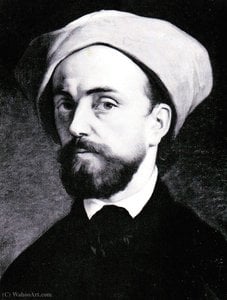
A Hungarian Voice in the Currents of Realism
Henrik Weber (1818-1866) stands as a cornerstone of Hungarian Realist painting—a figure whose unwavering commitment to truthful representation and profound understanding of national identity cemented his place among the most influential artists of the 19th century. Born in Pest on May 24th, 1818, Weber’s artistic journey began with an early fascination for drawing and a familial encouragement toward scholarly pursuits—a contrast that ultimately fueled his passion for visual art. His father, Mihaly Wéber, initially envisioned a scientific career for his son, yet Henrik's innate talent swiftly eclipsed such ambitions, directing him towards the tutelage of János Tóbiás Kärgling, a respected local artist who recognized and nurtured Weber’s burgeoning artistic potential.Weber’s formal education commenced in 1835 at the Academy of Fine Arts Vienna—a pivotal moment shaping his artistic trajectory. Under the guidance of Johann Ender and Leopold Kupelwieser, instructors who championed Realism as an antidote to academic formalism, Weber honed his skills and embraced a stylistic approach that prioritized accuracy and emotional resonance. Recognizing the financial constraints inherent in pursuing art professionally, he supplemented his studies through lithography—a skill that would prove invaluable throughout his career—and diligently sought commissions to sustain himself.
Vienna: The Seeds of Realism
Vienna proved instrumental in establishing Weber’s artistic convictions. Ender and Kupelwieser instilled within him a belief in portraying the world as it truly appeared, rejecting idealized representations for unflinching depictions of everyday life. This influence extended beyond technique; it fostered a deeper appreciation for observation and empathy—qualities that would permeate his subsequent works. Weber's early success as a portrait painter garnered considerable acclaim during the late 1830s, demonstrating his ability to capture the essence of his subjects with remarkable sensitivity.
Munich: Embracing Historical Narrative
Around 1840, Weber relocated to Munich—a strategic decision driven by diminishing demand for portraits in Vienna and fueled by a desire to pursue more ambitious artistic endeavors. This move coincided with an increasing fascination for historical painting—specifically scenes from Hungarian history. Faced with persistent difficulties securing lucrative commissions, Weber turned his attention to commemorating significant events and figures, resulting in masterpieces like The Death of John Hunyadi—a work that powerfully conveyed the drama and pathos of Hungarian national identity.
Italian Inspiration: Landscape and Genre
From 1845 to 1847, Weber traveled extensively through Italy—an experience profoundly shaping his artistic vision. He immersed himself in the landscapes of Tuscany and Umbria, capturing their beauty with meticulous detail and atmospheric color palettes. Simultaneously, he explored genre scenes depicting rural life—particularly depictions of peasant families—demonstrating an artist’s keen awareness of social realities and a commitment to portraying humanity with compassion.
A Legacy Enduring Through Time
Weber's artistic legacy extends beyond his individual paintings; he mentored younger artists, notably Károly Lotz, fostering the development of Hungarian Realism for decades to come. His meticulous technique—characterized by careful observation and masterful use of chiaroscuro—continues to inspire admiration among art historians and collectors alike. The Hungarian National Gallery proudly showcases numerous examples of Weber’s oeuvre, recognizing him as a pivotal figure in Hungarian artistic history—a painter who bravely championed Realism during a period of profound cultural transformation.
Furthermore, his lithographs documenting historical events for “Az Ország Tükre” (“The Mirror of the Country”) serve as invaluable visual records of Hungary’s formative years. Weber's unwavering dedication to artistic integrity and his profound understanding of national identity solidified his place as one of Hungary’s most enduring artistic voices—a testament to the transformative power of art.
Fragen & Antworten
Wie beliebt sind die Kunstwerke von Henrik Weber?
Die Seite Statistiken von Henrik Weber zeigt Statistiken, die aus den auf diese Website gelisteten Kunstwerken des Künstlers berechnet wurden.
Wie finde ich Werke von Henrik Weber in einer bestimmten Farbpalette?
Die Werke von Henrik Weber können auf der Nach Farbpaletten-Seite des Künstlers nach Farbpaletten durchsucht werden.
Wo sind die Kunstwerke von Henrik Weber nach Kunstrichtung gruppiert?
Die Stilrichtungen, in denen Henrik Weber tätig war, finden Sie auf der Alle Stilrichtungen-Seite des Künstlers, auf der die Kunstwerke nach Stilrichtung gruppiert sind.