A Legacy of Landscape: The Life and Art of Hendrik Pieter Koekkoek
Hendrik Pieter Koekkoek, born in 1843 and passing away in 1927, represents a fascinating continuation of the renowned Koekkoek family’s artistic dynasty. While often overshadowed by his father, Johannes Hermanus Koekkoek – also known as Jan Hendrik Koekkoek – Hendrik Pieter nonetheless carved out a significant place for himself within the landscape painting tradition of 19th-century Dutch art. He was not merely an imitator of familial styles but a skilled artist who adapted and refined the Romantic sensibilities that defined his lineage, particularly those associated with the Kleve school. The Koekkoeks were prolific; their name became synonymous with idyllic scenes of nature, often imbued with a melancholic beauty and meticulous detail. Hendrik Pieter inherited this predisposition, yet brought his own subtle nuances to bear on the canvas.
The Weight of Tradition: Early Life and Influences
To understand Hendrik Pieter Koekkoek’s work, one must first acknowledge the formidable shadow cast by his father. Jan Hermanus Koekkoek was a master of atmospheric perspective and detailed rendering, establishing a highly successful workshop that trained numerous artists – including his sons. Hendrik Pieter's early artistic development was undoubtedly shaped by this environment. He absorbed the techniques of landscape composition, the careful study of light and shadow, and the almost obsessive attention to naturalistic detail that characterized his father’s paintings. However, while Jan Hermanus often favored grand, sweeping vistas, Hendrik Pieter tended towards more intimate scenes, focusing on smaller pockets of nature – a tranquil forest path, a quiet riverbank, or a snow-covered field. This shift in scale suggests a desire for personal expression within the established framework of his family’s artistic practice. Beyond his father's direct influence, the broader Romantic movement played a crucial role. Artists like Barend Cornelis Koekkoek (Hendrik Pieter’s uncle) and other contemporaries fostered an appreciation for the sublime power of nature and its ability to evoke strong emotional responses.
A Kleve Romanticism Refined: Style and Technique
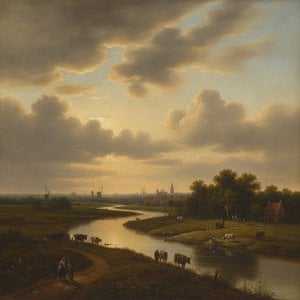
Hendrik Pieter Koekkoek is most readily associated with the Kleve Romanticism style, a branch of Dutch Romantic painting that flourished in the mid-19th century. This aesthetic prioritized detailed realism combined with an emotional connection to the landscape. His paintings are characterized by their exquisite rendering of light and atmosphere, creating a sense of depth and immersion. He possessed a remarkable ability to capture the subtle nuances of weather conditions – the soft glow of sunlight filtering through trees, the misty haze of a winter morning, or the dramatic shadows cast by storm clouds.
Unlike some of his contemporaries who embraced broader brushstrokes and looser compositions, Hendrik Pieter maintained a meticulous approach, carefully layering paint to achieve a highly polished finish. His palette typically consisted of muted earth tones – browns, greens, grays, and blues – which contributed to the overall sense of tranquility and realism in his work. He frequently depicted winter landscapes, perhaps drawn to the stark beauty and quiet solitude they offered.
These scenes often feature figures engaged in everyday activities—skaters on a frozen pond, farmers tending to their livestock—adding a touch of human warmth to the otherwise austere environment.
Major Themes and Historical Significance
Hendrik Pieter Koekkoek’s oeuvre primarily revolves around landscape and marine art. While he did not achieve the same level of widespread recognition as his father, his paintings were nonetheless sought after by collectors during his lifetime. His work reflects a broader cultural fascination with nature that emerged in the 19th century—a reaction against the rapid industrialization and urbanization of society. The idyllic scenes he depicted offered an escape from the harsh realities of modern life, providing viewers with a sense of peace and tranquility.
- Winter Landscapes: A recurring motif, showcasing his mastery of light and texture in snowy environments.
- River Scenes: Capturing the serenity and reflective qualities of Dutch waterways.
- Forest Interiors: Detailed depictions of woodland settings, emphasizing atmosphere and depth.
His historical significance lies not so much in groundbreaking innovation but in his skillful continuation and refinement of a beloved artistic tradition. He represents a link between the earlier generation of Koekkoek painters and the evolving landscape styles of the late 19th and early 20th centuries. While tastes shifted over time, Hendrik Pieter Koekkoek’s paintings continue to be appreciated for their technical brilliance, emotional resonance, and enduring beauty—a testament to the lasting legacy of the Koekkoek family within the world of Dutch art.