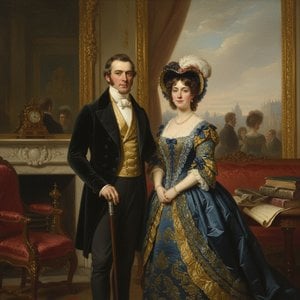
Gustav Freytag: A Voice of Realistic German Literature
Gustav Freytag (1816 – 1895) stands as a pivotal figure in the landscape of late 19th-century German literature, renowned for his compelling portrayals of middle-class life and his groundbreaking contributions to dramatic theory. Born in Kreuzburg, Haute-Silésie (now Kluczbork), Prussia, Freytag’s formative years instilled within him a deep appreciation for observation and meticulous detail – qualities that would become hallmarks of his artistic vision. He pursued academic excellence at the University of Breslau and Berlin, immersing himself in philology and gaining membership into the Corps Borussia Breslau, cementing his intellectual grounding.
- Early Life & Education: Freytag’s upbringing fostered a keen interest in social commentary and psychological realism. His studies provided him with invaluable tools for analyzing narrative structures and exploring human motivations.
- Journalistic Career & Political Engagement: From 1847, Freytag established himself as editor of Die Grenzboten, an influential liberal weekly, shaping public opinion through astute reporting and persuasive prose. He continued this role until 1861, followed by stints at Die Nation (1852) and Die Zeit (1867-1870), demonstrating his commitment to journalistic integrity and intellectual discourse.
Freytag’s literary output solidified his reputation as a master storyteller. His novels captivated audiences with their nuanced depictions of everyday life, examining themes of morality, ambition, and social responsibility. Notably, ‘Das Bild des Kaisers’ (1859) – arguably his magnum opus – meticulously dissects the psychological complexities surrounding Kaiser Wilhelm II's ascension to the throne, utilizing Freytag’s innovative “Pyramidische Struktur” (pyramidal structure), a technique he formalized and championed as a cornerstone of dramatic theory. This method emphasizes exposition, rising action, climax, falling action, and resolution—a framework that profoundly impacted subsequent playwrights and continues to be studied today.
- Dramatic Theory & Influence: Freytag’s ‘Die Technik des Dramas’ (1863) revolutionized theatrical practice by advocating for a structured approach to storytelling. He argued that dramatic narratives should mirror the pyramid structure, ensuring compelling pacing and maximizing emotional impact.
- Recognition & Legacy: Freytag received prestigious honors recognizing his scholarly achievements and artistic merit, including the Order of Maximilian for Science and Art from Bavaria and the Order Pour le Mérite for Science and Art from Wilhelm II. His enduring influence can be seen in the works of numerous writers who adopted his dramatic principles.
Freytag’s novels – ‘Die Verlorene Handschrift’ (1864) and others – remain treasured classics, offering invaluable insights into Victorian Germany and demonstrating Freytag's unwavering dedication to portraying human experience with unflinching honesty. He died peacefully in Wiesbaden in 1895, leaving behind a legacy as one of the most significant voices of German realism and a pioneer in dramatic methodology—a testament to his enduring contribution to both literature and theatrical art.