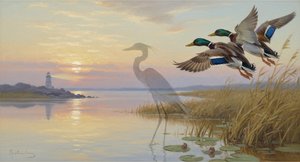
A Legacy of Wildlife: The Life and Art of Géza Vastagh
Géza Jenő Ferenc Vastagh, born in 1866 in Kolozsvár (modern-day Cluj-Napoca, Romania), emerged from a lineage steeped in artistic passion. His father, György Vastagh, was an established painter, instilling in his son a love for the visual arts from a young age. This familial creative spirit extended further; Géza’s brother, also named György, found success as a sculptor, and subsequent generations of the family continued to flourish in artistic pursuits—a testament to the enduring power of inherited talent and dedication. Géza's early education took place at a Piarist secondary school in Budapest, laying a foundation for his future endeavors before he embarked on formal training in Munich in 1886. There, he initially studied under Simon Hollósy, absorbing techniques that would later inform his distinctive style, and then refined his skills at the Academy of Fine Arts under the guidance of Gabriel von Hackl. His debut exhibition at the Glaspalast in 1887, featuring “Resting Peasant,” quickly garnered attention, even earning a purchase by Emperor Franz Joseph I—an early indication of his burgeoning talent and potential.
From Portraits to Primal Scenes
Vastagh’s artistic journey wasn't immediately focused on the wildlife that would define his career. Initially, he explored portraiture and genre scenes, demonstrating a keen eye for detail and composition. A brief return to Budapest in 1888 was followed by a study trip to France, where he honed his skills and broadened his exposure to diverse artistic influences. During this period, he actively sought opportunities to exhibit his work internationally, sending paintings to England and the United States—a sign of his ambition and desire for recognition beyond Hungarian borders. However, it was his growing fascination with animals, particularly cattle, that would ultimately shape his artistic identity. His painting “Ki a legény a csordában?” (Who is the Bachelor of the Herd?), awarded a gold medal, marked a turning point, leading to numerous large-scale canvases exploring themes related to rural life and animal husbandry. This shift in focus wasn’t merely stylistic; it reflected a deeper connection to the natural world and a desire to capture its raw beauty and untamed spirit.
The Allure of North Africa and the Lion's Domain
A pivotal moment arrived in 1898 when Vastagh received a state scholarship that enabled him to spend four months in Algeria and Tunisia. This journey proved transformative, immersing him in an environment radically different from Europe—a landscape teeming with exotic wildlife, most notably lions. He didn’t simply observe these majestic creatures; he meticulously studied their habits, living conditions, and behavior, capturing sketches and photographs alongside his observations. This dedication to realism, combined with a growing sense of empathy for his subjects, infused his paintings with an authenticity that resonated with audiences. The lion became his signature motif, appearing in countless canvases depicting scenes of power, tranquility, and primal struggle. He continued to refine his technique through studies at zoos in Hamburg, Leipzig, and Berlin, ensuring the anatomical accuracy and expressive vitality of his animal depictions.
Family, Landscapes, and a Lasting Impression
Vastagh’s personal life also played a role in shaping his artistic trajectory. His marriage to Margit Zsigmondy in 1906 brought stability and joy, and the couple raised three children together. While primarily known for his animal paintings, Vastagh occasionally deviated from his established themes, exploring landscapes in the Tatras Mountains—a brief but notable departure that showcased his versatility as an artist. Beyond his canvases, he contributed illustrations to Hungarian editions of Alfred Brehm’s renowned “Tierleben” (The Life of Animals), further demonstrating his commitment to capturing the natural world. A major retrospective exhibition in 1920 celebrated his life and work, followed by additional showcases honoring both him and his father in 1934 and the entire Vastagh family in 2004—a testament to their enduring legacy within Hungarian art history. Today, his works are prominently displayed at the Hungarian National Gallery and the Hungarian Agricultural Museum, ensuring that Géza Vastagh’s captivating depictions of wildlife continue to inspire and enchant generations to come.
Influences and Historical Significance
- György Vastagh (Father): The foundational influence, providing early artistic training and a familial connection to the world of painting.
- Simon Hollósy: A key instructor in Munich who helped shape Vastagh’s initial style and technique.
- Gabriel von Hackl: Another influential figure at the Academy of Fine Arts, further refining Vastagh's skills.
- Carl Rahl & Friedrich von Amerling (through his father): Influenced his early portrait work and attention to detail.
- Alfred Brehm: Collaboration on illustrations for “Tierleben” demonstrated a broader engagement with natural history illustration.
Vastagh’s significance lies in his ability to capture the essence of animals—their power, grace, and vulnerability—with remarkable realism and emotional depth. He stands as a master of Hungarian wildlife painting, bridging the gap between scientific observation and artistic expression. His work reflects a growing appreciation for the natural world during the late 19th and early 20th centuries, offering a glimpse into a time when artists sought to document and celebrate the beauty of untamed landscapes and their inhabitants.
His paintings are not merely representations of animals; they are windows into a primal realm, inviting viewers to connect with the wildness that exists both within nature and ourselves.