George Alsop: A Seventeenth-Century Portraitist of Land and Labor
George Alsop, a name perhaps less familiar than those of his contemporaries in the bustling art world of 17th-century England, nevertheless stands as a significant figure in the development of portraiture. Born around 1638 – the precise year remains shrouded in some uncertainty – and passing away in 1730, Alsop’s career spanned nearly a century, witnessing profound shifts in artistic style and social attitudes. His legacy rests primarily on his remarkably realistic depictions of landowners, servants, and the everyday lives of those who populated the English countryside, offering a rare glimpse into a world largely absent from the grand narratives of royal courts and aristocratic gatherings.
Early life details surrounding Alsop are scarce, adding to the mystique that clings to him. He was likely born in London, though his family’s origins remain somewhat elusive. What is known is that he received a basic apprenticeship, a common path for aspiring artists at the time, and later migrated to Maryland in 1658, driven by a desire for a new life and an opportunity to establish himself as a craftsman. This move proved pivotal, shaping not only his artistic practice but also his understanding of the social dynamics of colonial America.
The Colonial Voice: Maryland and Beyond
Alsop’s time in Maryland was formative. He quickly immersed himself in the realities of colonial life, documenting the lives of both landowners and their laborers with a keen eye for detail. His most celebrated work, “A Character of the Province of Mary-Land,” published in 1666, is a testament to this experience. This lengthy treatise wasn’t merely a descriptive account; it was an attempt to persuade English settlers to embrace the opportunities offered by the New World. It presented a surprisingly optimistic view of Maryland, highlighting its abundance and portraying its inhabitants with a degree of fairness rarely seen in colonial writings. The book's structure—divided into sections addressing the province’s geography, laws, customs, servant life, and even Native American relations—demonstrates Alsop’s methodical approach to observation and representation.
However, it is crucial to acknowledge that “A Character of Mary-Land” should be read with a critical eye. Alsop's account was undoubtedly shaped by his own perspective as an observer and a participant in colonial society. While he sought to present a balanced view, the work inevitably reflects his personal biases and desires to encourage emigration. Nevertheless, it remains a valuable primary source for understanding early Maryland life.
A Style Defined by Realism
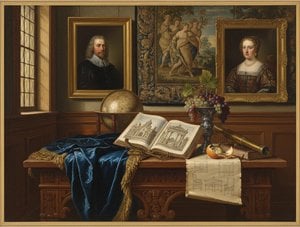
Alsop’s artistic style is characterized by its remarkable realism. Unlike the idealized portraits favored by many of his contemporaries, he depicted his subjects with an unflinching attention to detail—from the wrinkles on a landowner's face to the roughspun clothing of a servant. He employed techniques such as chiaroscuro – the dramatic use of light and shadow – to create depth and volume in his compositions. This approach wasn’t simply about accurate representation; it was about conveying a sense of immediacy and capturing the essence of his subjects.
His most famous works, “The Dudmaston Gamekeeper” (1723) and “The Boscobel Oak with a Medallion of William Penderel” (1651), exemplify this style. "The Dudmaston Gamekeeper" is particularly notable for its meticulous rendering of the hunter’s attire, his weathered face, and the surrounding landscape. “The Boscobel Oak,” an allegorical portrait, showcases Alsop's ability to integrate symbolic elements into a realistic composition, reflecting the Baroque influences prevalent in English art at the time.
Legacy and Historical Significance
George Alsop’s contribution to British art history is often overlooked, yet his work offers a unique window into the social and economic realities of 17th-century England. He wasn't a court painter or a member of the established artistic circles; instead, he was a keen observer who documented the lives of ordinary people—landowners, servants, and laborers—with remarkable skill and insight. His portraits provide valuable information about colonial life in Maryland and offer a counterpoint to the often romanticized narratives of early American settlement.
Furthermore, Alsop’s work reflects broader trends in European art during his lifetime – particularly the influence of Baroque painting, characterized by dramatic lighting, rich colors, and an emphasis on realism. His legacy lies not only in his individual works but also in his role as a chronicler of a changing society, capturing a moment in time with honesty and precision.