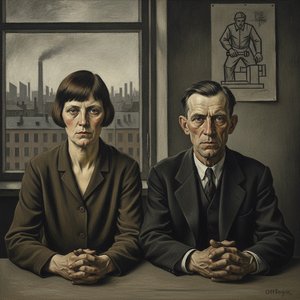
Franz Wilhelm Seiwert, born March 9, 1894, in Cologne, Germany, was the sole child of postal worker Johann Seiwert and Margarethe Düppenbecker. At the tender age of seven, he endured a devastating burn incident in 1901 resulting from experimental radiological treatment—an event that profoundly shaped his artistic vision and instilled within him an inescapable awareness of mortality. This formative trauma fueled his lifelong preoccupation with themes of fragility and suffering, informing much of his oeuvre.
artistic career
Seiwert’s artistic journey commenced at the Cologne School of Arts and Crafts from 1910 to 1914, where he honed foundational skills in painting and sculpture. Recognizing the burgeoning influence of Dadaism on European art circles, he swiftly embraced the movement's rebellious spirit and joined Dada activities in Cologne. Notably, he forged a collaborative partnership with Max Ernst, contributing significantly to Dada’s artistic explorations and challenging conventional aesthetic norms. However, Seiwert soon distanced himself from Cologne Dada, pursuing a path toward reconciling constructivism—a burgeoning trend emphasizing geometric forms and industrial materials—with realism, while simultaneously articulating uncompromising political convictions.
notable exhibitions and contributions
Seiwert's debut solo exhibition captivated audiences at the Kunstverein in Cologne in 1923, showcasing his distinctive artistic style and garnering critical acclaim. By the mid-1920s, he emerged as a pivotal figure within the “Gruppe Progressiver Künstler,” an influential collective dedicated to synthesizing constructivist principles with realistic representation—a mission underpinned by fervent advocacy for radical political reform. Recognizing the transformative potential of visual media in conveying complex ideological ideas, Seiwert spearheaded the establishment of “A bis Z,” a pioneering journal devoted to progressive art that championed figurative constructivism and presented groundbreaking artistic perspectives.
legacy and influence
Franz Wilhelm Seiwert’s enduring legacy resides in his singular contribution to the artistic landscape of the early 20th century. His masterful blend of constructivist aesthetics—characterized by bold geometric shapes and simplified forms—with unwavering political engagement cemented his position as a trailblazer whose work continues to inspire artists across generations. He profoundly impacted the development of German art, particularly during the Weimar Republic era, fostering dialogues between artistic experimentation and social critique. Seiwert’s exploration of themes like vulnerability, resilience, and the human condition resonated deeply with contemporaries and solidified his place among the most significant voices of his time. His work remains a testament to the power of art as a vehicle for expressing political convictions and confronting societal injustices—a legacy that continues to inspire artistic discourse today.
Vom WahooArt.com Redaktionsteam
Kunst-Quiz
Jede Frage hat nur eine richtige Antwort.
Frage 1:
Wie wurde Franz Wilhelm Seiwert geboren?
Frage 2:
Mit welchem Künstler verband sich Seiwert im Jahr 1919?
Frage 3:
Welche künstlerische Richtung prägte Seiwerts Werk hauptsächlich?
Frage 4:
In welchem Jahr fand eine große Dada-Ausstellung in Köln statt?
Explore the profound impact of Constructivism on modern art. Discover how geometric abstraction and industrial aesthetics revolutionized design, from avant-garde textiles to architectural mastery, curated for the discerning art collector seeking depth and historical significance.
Explore the raw emotion of German Expressionism through a definitive guide to Ernst Ludwig Kirchner. Discover how his bold colors and distorted forms redefined modern art history, from Berlin street scenes to iconic masterpieces.
WConciergeOnline · antwortet innerhalb einer Minute
Hallo! Ich kann Ihnen dabei helfen, ein Kunstwerk auszuwählen, eine Bestellung zu verfolgen oder Fragen zur Garantie zu beantworten. Wie kann ich Ihnen heute behilflich sein?