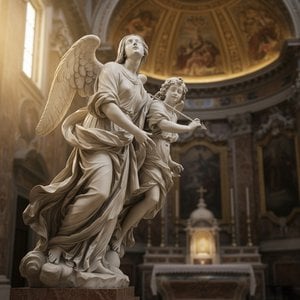
François La Bourbourère: A Roman Baroque Visionary
François La Bourbourère (Francesco Laboureur), born in Rome around 1661, stands as a significant contributor to the vibrant artistic landscape of the Italian Baroque and Rococo eras. His legacy resides primarily in exquisitely rendered portraits and genre scenes that captured the spirit of aristocratic Roman society during his lifetime – a testament to his skill and discerning eye for detail.
- Early Life & Training: La Bourbourère’s artistic journey began under the tutelage of Giovanni Battista Gaulli, a celebrated baroque sculptor who instilled in him a foundational understanding of sculptural principles alongside painting techniques. This formative influence undoubtedly shaped his later stylistic choices.
- Notable Patronage & Artistic Output: He gained considerable renown through collaborations with influential families like the Bourbon and Medici dynasties, securing commissions for grand portraits and theatrical productions that showcased their prestige. Among his most celebrated works is “Portrait of Cardinal Pacca,” a masterful depiction demonstrating exceptional realism and capturing the sitter’s character with remarkable sensitivity.
- Style & Technique: La Bourbourère's artistic style embodies the hallmarks of Rococo, characterized by delicate brushstrokes, pastel hues, and an emphasis on illusionistic effects. He skillfully employed chiaroscuro – dramatic contrasts between light and shadow – to heighten emotional impact and create a sense of depth within his canvases.
- Influence & Legacy: Though overshadowed by contemporaries like Caravaggio and Bernini, La Bourbourère nonetheless exerted considerable influence on subsequent generations of artists. His meticulous attention to observation and his ability to convey psychological nuance cemented his position as a pivotal figure in the Roman Baroque tradition.
His paintings are housed in museums across Italy, including the Musée National de la Renaissance in Paris, offering visitors an opportunity to appreciate firsthand the beauty and sophistication of his artistic vision. La Bourbourère’s contribution to Italian art history underscores the enduring power of observation and emotional expression within the Baroque aesthetic.