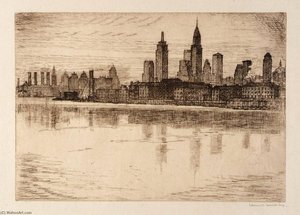
Edward S. Hewitt: A Chronicle of Urban Decay and Enduring Grit
Edward S. Hewitt’s legacy isn't one of grand, sweeping landscapes or revolutionary artistic movements. Instead, he carved a distinctive niche within American art—a meticulous observation of the gritty realities of late 19th-century New York City. Born in Brooklyn in 1877 and passing away in 1962, Hewitt possessed an almost obsessive dedication to capturing the city’s industrial heart, its towering tenements, and the lives lived within their shadowed depths. His work isn't romanticized; it’s a stark, unflinching portrayal of urban decay, punctuated by moments of surprising beauty and quiet dignity.
Hewitt’s artistic journey began with studies in Paris, a period that profoundly shaped his approach to composition and technique. However, he quickly returned to the United States, drawn back to the familiar rhythms and textures of New York. Unlike many artists of his era who sought to idealize urban life, Hewitt embraced its imperfections—the soot-stained brickwork, the crumbling facades, the perpetually overcast skies. He was a keen observer of detail, meticulously rendering every crack, every rust stain, every flickering gaslight. This commitment to realism, combined with a masterful understanding of light and shadow, created images that are both deeply evocative and undeniably authentic.
The Palette of Progress: Technique and Influences
Hewitt’s technical skill is immediately apparent in his etchings and drypoints. He was particularly adept at capturing the effects of light on metal surfaces—the glint of a factory chimney, the sheen of a rain-slicked street. His use of monochrome often heightened this effect, emphasizing texture and form rather than relying on color to create visual interest. He frequently employed a technique known as “drypoint,” which produces a velvety, almost painterly quality in his lines. This method allowed him to build up layers of tone and create subtle gradations of light and shadow—a crucial element in conveying the atmosphere of his urban scenes.
While Hewitt’s work is undeniably rooted in realism, it's also influenced by a broader range of artistic traditions. The influence of Gustave Caillebotte, a French Impressionist known for his depictions of industrial life, is particularly evident in Hewitt’s focus on capturing the atmosphere and energy of urban environments. Furthermore, there’s a subtle connection to the social realism movement, which sought to depict the lives of working-class people with honesty and compassion. However, Hewitt's approach remained distinctly individual—he wasn’t interested in simply documenting poverty; he was fascinated by the resilience and dignity of those who inhabited these challenging spaces.
White Towers from Governors Island: A Glimpse into Industrial Grandeur
One of Hewitt’s most striking works, “White Towers from Governors Island,” offers a powerful testament to his artistic vision. This monochromatic etching captures the imposing skyline of New York City as seen from Governors Island—a vantage point that provides a unique perspective on the city's towering structures. The image is dominated by the stark white facades of the buildings, which are rendered with remarkable precision and detail. The composition is carefully balanced, drawing the eye upward towards the distant horizon. Despite the lack of color, the etching conveys a sense of immense scale and power—a feeling that reflects the city’s rapid industrial growth.
Hewitt's ability to transform a seemingly mundane subject – a cityscape – into a work of profound artistic merit is evident in this piece. It’s not merely a topographical representation; it’s an exploration of light, texture, and form—a meditation on the relationship between humanity and its environment. The etching invites us to contemplate the city's relentless progress and the human cost of that progress.
Harbor 6 Liberty: Maritime Echoes and Urban Reflections
"Harbor 6 Liberty" further exemplifies Hewitt’s talent for capturing the interplay between urban landscapes and maritime scenes. This etching depicts a harbor filled with ships, warehouses, and industrial structures—a quintessential image of late 19th-century New York. The composition is dynamic, with the boats creating diagonal lines that draw the eye across the canvas. The artist skillfully renders the reflections on the water’s surface, adding depth and complexity to the scene.
Beyond its technical merits, “Harbor 6 Liberty” also offers a glimpse into the city's economic life—a vital industry centered around shipping and trade. The presence of numerous vessels suggests the bustling activity of the port, while the warehouses hint at the vast quantities of goods being handled there. Hewitt’s work serves as a visual record of this important aspect of New York City’s history.
A Legacy in Detail: Hewitt's Enduring Significance
Edward S. Hewitt may not be a household name, but his contribution to American art is significant and deserves recognition. His meticulous attention to detail, combined with his ability to capture the atmosphere of urban decay, has earned him a place among the most important artists of his generation. His work offers a valuable perspective on the social and economic history of New York City—a city that was undergoing rapid transformation during his lifetime. Hewitt’s legacy lies not in grand pronouncements or revolutionary ideas, but in the quiet dignity of his observations—a testament to the enduring power of realism and the beauty that can be found even in the most unlikely places.