The Artisan's Legacy: The Life and Art of Claude Jacquand
Born into a world of meticulous craftsmanship in Lyon, France, on December 11, 1803, Claude Jacquand—often referred to as Claudius Jacquand—carried the precision of his lineage into the grand halls of French art. The son of a comb-maker, Jacquand’s early years were steeped in an appreciation for fine detail and manual dexterity, qualities that would later define his brushwork. His journey began at the École nationale des beaux-arts de Lyon under the guidance of Fleury François Richard, where he mastered the foundational rigors of academic painting. This period of intense training instilled in him a profound respect for anatomical accuracy and tonal modulation, preparing him for the dramatic shifts that would characterize his later career.
The trajectory of Jacquand’s life took a transformative turn following the death of his mother in 1836. Drawn by the magnetic pull of the art capital, he moved to Paris, a transition that served as the catalyst for his professional ascent. It was in this vibrant, often turbulent era of French history that Jacquand began to carve out a reputation for excellence. His talent did not go unnoticed by the prestigious institutions of his time; by 1839, he had been knighted in the Legion d'Honneur, and within a year, he was receiving international acclaim, including a Gold Medal at an exposition in Brussels and the Order of Leopold following another triumph in The Hague. These accolades placed him among the respected figures of the Romantic era, even as he navigated the complexities of a changing social landscape.
A Tapestry of History and Emotion
Jacquand’s oeuvre is a captivating exploration of historical narratives, religious devotion, and the intimate nuances of genre scenes. He possessed a rare ability to breathe life into the past, transforming static historical tableaus into breathing, emotional experiences. His works often functioned as windows into bygone eras, utilizing chiaroscuro lighting and rich, textured palettes to evoke the atmosphere of the Renaissance and the Baroque periods. Whether depicting the intellectual gravity of an 18th-century gathering or the dramatic tension of a royal encounter, Jacquand’s compositions were marked by a profound sense of storytelling.
His thematic range was remarkably broad, encompassing:
- Historical Tableaus: Grand narratives such as Louis XI of France Surprising the Queen, which utilized dramatic lighting to capture moments of intense political and personal intrigue.
- Religious Subjects: Devotional works that showcased his ability to handle sacred themes with both reverence and technical mastery.
- Genre Scenes: Intimate glimpses into daily life, such as the Guard Room Scene, which offered viewers a sense of camaraderie and historical authenticity.
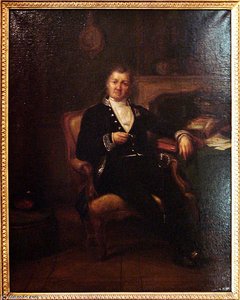
- Intellectual Portraits: Capturing the essence of Enlightenment figures like Voltaire, where he focused on the psychological depth and contemplative nature of his subjects.
Evolution and Enduring Influence
As the art world shifted from the strictures of Classicism toward the emotional volatility of Romanticism and eventually the light-drenched experiments of Impressionism, Jacquand demonstrated a remarkable stylistic fluidity. While his roots remained firmly planted in the academic tradition—characterized by smooth surfaces and balanced compositions—his later works began to embrace more subtle color harmonies and atmospheric effects. This evolution reflects an artist who was not merely a chronicler of the past, but a participant in the living, breathing progression of French art history.
Despite the financial hardships that shadowed his later years following the French Revolution of 1848, Jacquand’s commitment to his craft never wavered. He lived through a period of immense social upheaval, yet he continued to exhibit regularly, maintaining a standard of excellence that earned him the respect of critics like Charles Baudelaire. Though history sometimes remembers his contemporaries more vividly, the legacy of Claude Jacquand remains etched in the meticulous detail and emotional resonance of his canvases. His life stands as a testament to the power of craftsmanship, representing a bridge between the disciplined traditions of the old masters and the expressive freedom of the modern age.