Carl Frederik Peder Aagaard: Painter of Tranquil Landscapes and Decorative Splendor
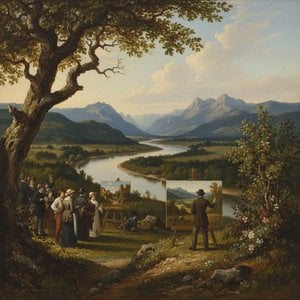
Carl Frederik Peder Aagaard (1833-1895) occupies a prominent place in Danish art history, revered primarily for his serene landscapes characterized by understated elegance and his substantial contributions to decorative arts. Born into a shoemaker’s family—a humble origin that belied the extraordinary artistic trajectory he would undertake—Aagaard's journey began modestly but swiftly ascended through meticulous study and unwavering dedication—qualities that would permeate every facet of his career. His formative years were spent honing his skills in Odense before relocating to Copenhagen in 1852, where he joined forces with his brother Johan, a woodcutter, fostering an environment profoundly supportive of artistic cultivation. Aagaard’s academic pursuits extended far beyond mere drawing; he immersed himself wholeheartedly in etching and decorative painting techniques—a deliberate choice reflecting the prevailing artistic sensibilities of his time—guided by the invaluable mentorship of Georg Hilker at the Royal Danish Academy of Fine Arts. This grounding in craftsmanship proved instrumental as he transitioned towards landscape painting, studying under P.C. Skovgaard—a partnership that yielded particularly noteworthy results. Notably, Aagaard collaborated with Hilker to adorn the entrance hall of the Royal Veterinary and Agricultural University—a project emblematic of Denmark’s burgeoning interest in public spaces and artistic embellishment during his era—demonstrating a keen awareness of architectural trends and their communicative power. Furthermore, he contributed decorative borders for Wilhelm Marstrand’s murals at Roskilde Cathedral alongside Heinrich Hansen—a testament to his understanding of monumental art and its role in shaping civic identity—reflecting the grandeur of Scandinavian history and tradition. Beyond institutional collaborations, Aagaard pursued independent commissions—decorating frijsenborg, the Dagmar Theater (da), and the National Scala—solidifying his reputation as a versatile artist adept at adapting to diverse artistic demands. His landscapes captivated audiences with their depiction of idyllic locales frequented by tourists—scenes meticulously rendered not merely for visual beauty but also for conveying an atmosphere imbued with emotion—capturing the essence of Danish summers and establishing him as a master of tonal subtlety. The award of the Neuhausenske Prize in 1857 for “Autumn Morning at the Jægersborg Dyrehave”—a scene bathed in golden light and rendered with breathtaking precision—marked a pivotal moment in his artistic career, securing him recognition as a leading voice within the Danish landscape tradition and cementing his legacy as one of Denmark’s most celebrated painters. Inspired by Italian scenery during two extended expeditions undertaken between 1870 and 1875—a formative experience that broadened his artistic horizons—Aagaard’s stylistic sensibilities matured further. These journeys fueled his fascination with capturing fleeting moments of natural grandeur—particularly the dramatic vistas of Amalfi—and informed his compositional choices, resulting in works characterized by a masterful blend of Romantic idealism and meticulous observation. His marriage to Anna Pio (née Pierre Theodore Pio) brought him a cherished family life—a grounding influence that balanced his artistic pursuits with domestic responsibilities—and he was elected a member of the Royal Academy in 1874—a testament to his respected standing within the Danish artistic community and acknowledging his profound contribution to Danish art history. Subsequently appointed Professor at Copenhagen University in 1892—a role he held until his death—Aagaard continued to nurture young talent and disseminate knowledge about art history, ensuring that his artistic vision endured beyond his lifetime. Aagaard’s home was designed by architect Vilhelm Dahlerup using stones from the demolished Royal Danish Theater—a poignant reminder of Denmark's cultural heritage and a symbol of artistic continuity—reflecting the values of craftsmanship and tradition central to his worldview. Declared a Cultural Monument in 1977, his dwelling stands as an enduring legacy of his life’s work and artistic vision—a testament to the transformative power of art and its ability to inspire generations to come.- Notable Achievements: Neuhausenske Prize (1857), Sødringske Opmuntrings Prize (1865)
- Collaborations: Royal Veterinary & Agricultural University Entrance Hall Decoration, Roskilde Cathedral Border Decorations
- Influences: P.C. Skovgaard, Georg Hilker