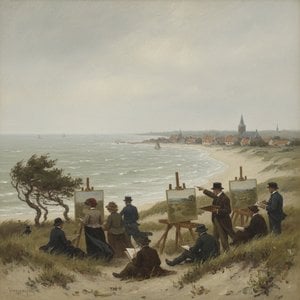
Eine böhmische Seele inmitten Wiener Grandezza
Das Leben von Anton Romako war ein Wandteppich, gewebt aus den Fäden sozialer Komplexität und künstlerischer Rastlosigkeit. Geboren im Jahr 1834 in Atzgersdorf, trat der Künstler in eine Welt unter Umständen, die seine Wahrnehmung von Identität und Zugehörigkeit für immer prägen sollten. Als unehelicher Sohn von Josef Lepper, einem Fabrikanten, und Elisabeth Maria Anna Romako, einer tschechischen Hausmagd, waren seine frühen Jahre von einem tiefen Gefühl des Außenseitertums geprägt. Diese immanente Spannung zwischen seiner bescheidenen Herkunft und der aufstrebenden Pracht der Wiener Ringstraßenära wurde zum treibenden Motor seines schöpferischen Geistes und befeuerte eine lebenslange Suche danach, die psychologische Tiefe unter der Oberfläche des imperialen Glanzes einzufangen.
Romakos Weg durch die Hallen der künstlerischen Tradition verlief alles andere als geradlinig. Sein erster Vorstoß an die Wiener Akademie der bildenden Künste erwies sich als eine Zeit erheblicher Reibung; die konservativen Dogmen Ferdinand Georg Waldmüllers, der den jungen Studenten berüchtigt als talentlos abtat, wirkten nicht etwa abschreckend, sondern als kraftvoller Katalysator. Diese frühe Ablehnung drängte Romako zu den weiteren Horizonten Münchens und schließlich in die sonnendurchfluteten Landschaften Italiens. Indem er sich in das Erbe von Tizian und Raffael vertiefte, begann er, einen Stil zu synthetisieren, der sich vom starren Akademismus weg hin zu etwas weitaus Emotionalerem und Fließenderem entwickelte.
Die Evolution von Technik und Vision
Die wahre Metamorphose von Romakos Handschrift lässt sich auf seinen Privatunterricht bei Carl Rähl zurückführen. Durch Rähl entdeckte der Künstler die Macht des lockeren Pinselstrichs und der subtilen Modulation der Töne – Techniken, die es ihm ermöglichten, der Atmosphäre selbst Leben einzuhauchen. Dieser Einfluss verankerte seine Landschaften im Geiste der Barbizon-Schule, in der er danach strebte, die sublime, melancholische Schönheit der österreichischen Landschaft durch atmosphärische Perspektive statt durch bloße topografische Genauigkeit einzufangen.
Als seine technische Meisterschaft wuchs, vollzog Romako den Übergang von der Stille der Natur zum dramatischen Theater der menschlichen Geschichte und des Charakters. Sein Werk begann eine Faszination für das psychologische Gewicht seiner Motive widerzuspiegeln, insbesondere in seinen Porträts und historischen Kompositionen. Er besaß die seltene Fähigkeit, nicht nur die physische Ähnlichkeit der Wiener Elite darzustellen, sondern auch die zugrunde liegenden Spannungen und flüchtigen Emotionen einer Epoche am Rande des Umbruchs. Seine Gemälde dienen oft als Fenster zur Seele, in denen das Zusammenspiel von Licht und Schatten die inneren Konflikte seiner Dargestellten widerspiegelt.
Vermächtnis und künstlerische Bedeutung
Obwohl er sich in einer komplexen sozialen Landschaft bewegte, bleibt Romakos Beitrag zur Kunst des 19. Jahrhunderts unauslöschlich. Er fungierte als Brücke zwischen der traditionalistischen Vergangenheit und der aufkeimenden Moderne, die die europäische Malerei bald neu definieren sollte. Seine Fähigkeit, die historische Schwere seiner Sujets mit einer expressiven, fast proto-expressionistischen Technik zu verbinden, erlaubte es ihm, das eigentliche Wesen der Ringstraßenära einzufangen – eine Periode immensen äußeren Wachstums, die tiefe innere Verschiebungen verbarg.
Heute liegt die Bedeutung von Anton Romako in seiner Rolle als Wegbereiter, der sich weigerte, durch die ihm auferlegten Etiketten begrenzt zu werden. Sein Œuvre steht als Zeugnis für die Kraft künstlerischer Resilienz und beweist, dass man selbst von den Rändern der Gesellschaft aus eine Vision erschaffen kann, die das Zentrum der Kunstwelt beansprucht. Durch seine Porträts und historischen Szenen hinterließ er ein tiefgreifendes Zeugnis einer verschwundenen Ära, geschaffen mit einer Sensibilität, die das moderne Auge auch heute noch in seinen Bann zieht.
Fragen & Antworten
Woher kommt Anton Romako?
Anton Romako wurde in Österreich geboren.
Wo sind die Kunstwerke von Anton Romako nach Schlagworten gruppiert?
Um Werke von Anton Romako zu einem bestimmten Thema zu finden, nutzen Sie die Nach Schlagworten-Seite des Künstlers, auf der die Kunstwerke nach Schlagworten gruppiert sind.
Kann ich die Werke von Anton Romako nach Themen durchsuchen?
Die Seite Themenatlas ordnet die Kunstwerke von Anton Romako nach Themen an.