Early Life and Artistic Foundations
Alphonse Jongers, born on November 17, 1872, in Mézières, France, embarked on a journey that would see him become a respected figure within the Impressionist movement, bridging artistic communities across continents. His initial training at the prestigious École des Beaux-Arts under luminaries like Delaunay and Gustave Moreau laid a solid foundation for his future explorations in painting. This formal education was further enriched by two years of study in Spain, exposing him to diverse artistic traditions that would subtly influence his developing style. In 1895, a pivotal move brought Jongers to French Canada, where he established a studio in Montreal at the remarkably young age of twenty-three. It was during this period that he likely forged a significant friendship with Henry Ward Ranger, an American artist who frequently visited Montreal and would later play a crucial role in introducing Jongers to the burgeoning art colony in Old Lyme, Connecticut.
The Allure of Old Lyme and Impressionistic Expression
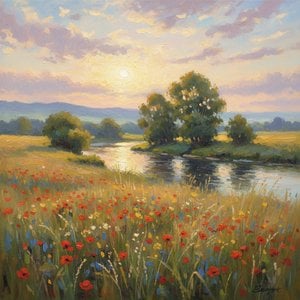
The year 1900 marked a turning point in Jongers’ career as he relocated to New York City before making his first foray into Old Lyme, drawn by Ranger's encouragement. He quickly became an integral member of the Old Lyme Art Colony, immersing himself in its vibrant atmosphere and embracing the principles of Impressionism. Jongers distinguished himself through his captivating landscapes and still lifes, characterized by a delicate interplay of light and color that captured the essence of the Connecticut countryside. His work resonated with a growing audience, leading to exhibitions and recognition within artistic circles. A particularly notable achievement during this period was his portrait of Florence Griswold, affectionately known as “the keeper” of the Lyme Art Colony. This painting, commissioned in 1903, became an iconic representation of the colony itself, embodying its spirit and charm. The story behind its creation—Jongers’ request for Miss Griswold to send her harp to his New York studio to complete the canvas—adds a layer of intimacy and dedication to the artwork.
Transatlantic Career and Artistic Recognition
Jongers' artistic pursuits weren’t confined by geographical boundaries. He skillfully navigated between New York City, Montreal, and Old Lyme, establishing a diverse network of patrons and fellow artists. His presence in New York facilitated his inclusion in group exhibitions, notably one held at the Durand-Ruel Galleries in 1902 alongside other prominent Lyme artists like Louis Paul Dessar and George Bogert. Throughout his career, Jongers received numerous accolades for his contributions to the art world. He was elected a member of the Society of American Artists and became an Associate of the National Academy of Design in 1906. Further recognition came with silver and bronze medals at prestigious exhibitions—the St. Louis Exposition in 1904 and the Salon of French Artists in 1909, respectively—culminating in his appointment as a Member of the Légion d'Honneur in 1912. His works found their way into esteemed collections, including those of the Musée de Lille, the Musée des Beaux-Arts de Liège, the Metropolitan Museum of Art in New York, and the National Gallery of Art in Washington D.C., solidifying his reputation as a significant artistic voice.
Later Life and Legacy
In 1924, Jongers returned to Montreal, where he continued to flourish as a portrait painter, earning a reputation as one of Canada’s leading artists in the genre. He became a familiar figure at the Ritz-Carlton Hotel, known not only for his artistic talent but also for his engaging personality and witty observations. His death on October 2, 1945, at the Ritz-Carlton marked the end of a prolific career. A memorial exhibition held at the Montreal Art Association in 1947 served as a tribute to his life and work, celebrating his enduring contributions to both Canadian and American art. Jongers’ legacy lies not only in the beauty and skill of his paintings but also in his ability to capture the spirit of his time—the elegance of society portraiture blended with the vibrant energy of Impressionism. His works continue to be admired for their delicate brushwork, evocative use of color, and insightful portrayals of both people and landscapes.
Influences and Artistic Style
Jongers’ artistic style was a fascinating synthesis of various influences. His early training at the École des Beaux-Arts instilled in him a strong understanding of classical techniques, while his time in Spain exposed him to different approaches to composition and color. However, it was his embrace of Impressionism—particularly through his association with Henry Ward Ranger and the Old Lyme Art Colony—that truly defined his artistic vision. He masterfully adopted the Impressionist principles of capturing fleeting moments of light and atmosphere, employing a loose brushstroke and vibrant palette to create paintings that were both visually striking and emotionally resonant. His portraits, in particular, reveal a keen sensitivity to character and personality, often imbued with a sense of warmth and intimacy. While rooted in Impressionism, Jongers also demonstrated an affinity for Art Nouveau aesthetics, evident in the decorative elements and elegant compositions found in some of his works. This unique blend of influences set him apart as an artist who successfully bridged different artistic movements and created a style that was distinctly his own.