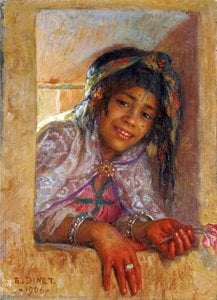
Der Pariser Gelehrte und der algerische Traum
Geboren im Herzen von Paris am 28. März 1861, begann Alphonse-Étienne Dinet seine Reise in den prestigeträchtigen Hallen des Lycée Henry IV. Als Sohn eines bedeutenden französischen Richters war sein frühes Leben geprägt von wissenschaftlicher Strenge und der kultivierten Atmosphäre der Belle Époque. Seine formale Ausbildung an der Académie Julian und der École nationale supérieure des Beaux-Arts verlieh ihm das technische Können der französischen akademischen Tradition, doch unter diesem klassischen Fundament verbarg sich eine wachsende Neugier, die ihn schließlich weit über die Grenzen Frankreichs führen sollte. Es war seine Begegnung mit dem Maghreb, die seinen künstlerischen Geist wahrhaft entfachte und einen Schüler französischer Tradition in einen Chronisten nordafrikanischen Lebens verwandelte.Eine durch die Wüste transformierte Seele
Dinet’s Beziehung zu Algerien war weit mehr als nur ein rein berufliches Interesse; es war eine tiefgreifende spirituelle und kulturelle Metamorphose. Als er in die Landschaften und Bräuche der Region eintauchte, begannen die Grenzen zwischen dem Beobachter und dem Beobachteten zu verschwimmen. Diese tiefe Verbindung gipfelte in seinem Übertritt zum Islam, was dazu führte, dass er den Namen Nasreddine Dinet annahm – ein Titel, der „Verteidiger des Dīn“ bedeutet. Dies war nicht bloß eine Änderung der Namensgebung, sondern ein fundamentaler Perspektivwechsel. Durch die Beherrschung des Arabischen und die Übersetzung seiner Literatur erlangte er ein intimes, innerliches Verständnis der Kultur, die er darstellte. Sein Werk war nicht länger das eines Außenstehenden, der von außen hineinblickt; stattdessen wurde es zu einer seelenvollen Dokumentation eines Lebens, das er wahrhaft angenommen hatte, gekennzeichnet durch ein nie dagewesenes Maß an ethnographischer Authentizität.Die Meisterschaft des Lichts und der ethnographischen Wahrheit
Die Kunstfertigkeit von Nasreddine Dinet definiert sich durch eine atemberaubende Synthese aus romantischem Idealismus und akribischer Beobachtung. Inspiriert von der meisterhaften Nutzung von Licht und Farbe, wie man sie in den Werken von Eugène Delacroix findet, besaß Dinet die unheimliche Fähigkeit, die wechselnde Atmosphäre der algerischen Sonne einzufangen. Seine Leinwände leben von der Wärme der Wüste und den zarten Nuancen des täglichen Daseins. Ob er die dramatische Intensität von L’Oued M'sila après la pluie darstellt oder die stille, bewegende Unschuld in Girl Playing With Her Brother einfängt – seine Pinselstriche vermitteln sowohl wissenschaftliche Genauigkeit als auch tiefe emotionale Resonanz. Er hielt die Texturen von Stoffen, das Körnige des Sandes und das sanfte Glühen der Dämmerung mit einer Präzision fest, welche die Würde seiner Motive ehrte.Ein bleibendes Vermächtnis in der orientalistischen Kunst
Über seine einzelnen Leinwände hinaus war Dinets Einfluss auf die Kunstwelt strukturell und dauerhaft. Als einer der Gründer der Société des Peintres Orientalistes half er dabei, die Richtung der Bewegung mitzugestalten, indem er sie zu einer respektvolleren und authentischeren Darstellung des nordafrikanischen Lebens lenkte. Seine Fähigkeit, den Exotismus des Orients mit der technischen Raffinesse der französischen Malerei zu verbinden, hinterließ einen unauslöschlichen Eindruck in der Kunstgeschichte. Heute bleiben seine Werke lebendige Zeugnisse einer Zeit intensiven kulturellen Austauschs und stehen als leuchtende Fenster in eine Welt, in der Kunst, Glaube und Landschaft in perfekter, sonnendurchfluteter Harmonie zusammenfanden.Fragen & Antworten
Woher kommt Alphonse-Étienne Dinet?
Alphonse-Étienne Dinet wurde in Frankreich geboren.
Wie viele Kunstwerke von Alphonse-Étienne Dinet können durchstöbert werden?
Sie können 58 Kunstwerke Werke von Alphonse-Étienne Dinet auf der Seite Alle Kunstwerke durchstöbern.
Wo kann ich die Kunstwerke von Alphonse-Étienne Dinet in einer virtuellen 3D-Galerie erleben?
Die Virtuelle 3D-Galerie von Alphonse-Étienne Dinet präsentiert die Kunstwerke des Künstlers in einer virtuellen dreidimensionalen Galerie.