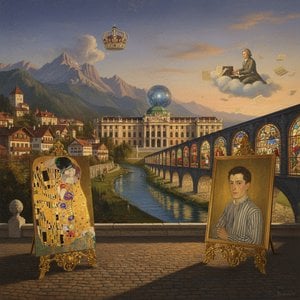
Alexander von Zemlinsky (1871–1942): Bridging Romanticism and Modernism
As an Austrian composer, conductor, and teacher, Alexander von Zemlinsky left an indelible mark on the art world. Born in Vienna in 1871, Zemlinsky’s life was a testament to his unwavering passion for music and his profound influence on shaping the Second Viennese School—a movement that irrevocably altered the course of musical history.
Early Life and Education
Zemlinsky's formative years were steeped in musical scholarship at the Vienna Conservatory, where he diligently honed his skills under the tutelage of esteemed composers like Gustav Mahler and Franz Schubert. Crucially, his friendships with Arnold Schoenberg—who would later marry Zemlinsky’s sister Mathilde—established a connection that profoundly shaped his artistic trajectory. This collaborative spirit fostered an environment ripe for experimentation and innovation.
Artistic Contributions and Legacy
Zemlinsky's musical output was characterized by a remarkable synthesis of late Romanticism and modernist techniques, particularly atonality and twelve-tone music – concepts championed by Schoenberg himself. He wasn’t merely absorbing trends; he actively participated in their genesis, becoming a mentor to luminaries like Schoenberg, Alban Berg, and Anton Webern. Zemlinsky's compositions stand as monuments to this pivotal period, demonstrating his mastery of orchestration and harmonic complexity. Notable works include “Verklärte Nacht” (1899), a haunting string sextet that captures the essence of Romantic melancholy, and collaborations with Schoenberg that solidified the foundations of avant-garde musical thought.
Notable Collaborations and Influences
Zemlinsky’s artistic journey was inextricably linked to the Second Viennese School's intellectual ferment. His mentorship nurtured Webern’s distinctive style—a minimalist aesthetic rooted in tonal reduction—and Berg’s exploration of dramatic expression within a modernist framework. Schoenberg’s pioneering work on atonality and serialism served as an undeniable catalyst for Zemlinsky’s own compositional explorations, cementing his position as a central figure in musical innovation.
A Rediscovered Master
Zemlinsky's legacy continues to inspire musicians today. His contributions to the Second Viennese School fundamentally reshaped Western music, demonstrating that artistic breakthroughs often emerge from dialogues between tradition and experimentation. Explore WahooArt’s comprehensive collection of Zemlinsky’s works—a celebration of a composer who bridged eras and redefined musical boundaries.
A journey through art history with WahooArt’s extensive collection.