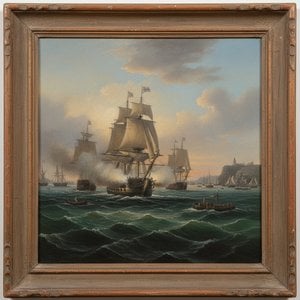
Albert Savery: The Painter of Tranquil Shores
Albert Savery (1736 – 1809) stands as a singular figure in Dutch Golden Age art, renowned not for grand historical narratives or mythological allegories but for his masterful depiction of coastal landscapes and serene seascapes. Unlike many of his contemporaries who sought to impress with dramatic vistas or heroic subjects, Savery cultivated a quiet aesthetic—a deliberate choice that cemented his reputation as one of the most influential painters of his era.Born in Amsterdam in 1736, Savery’s artistic inclinations emerged early. His father, a linen draper, recognized his son's talent and encouraged him to pursue painting professionally. He received instruction from Johann Christian Feyens, a prominent Haarlem landscape painter, establishing a foundational understanding of tonal painting and atmospheric perspective—techniques that would become hallmarks of Savery’s distinctive style.
- Early Life & Training: Savery's formative years were marked by an appreciation for artistic pursuits instilled by his father. Feyens’ guidance proved invaluable in shaping Savery’s technical skills, equipping him with the foundational knowledge necessary to excel in landscape painting.
- Amsterdam Workshop & Artistic Development: Around 1760, Savery established his own workshop in Amsterdam, attracting a cohort of talented pupils who diligently honed their craft under his watchful eye. This collaborative environment fostered experimentation and innovation, propelling Savery’s artistic evolution beyond mere imitation.
Savery's technique involved layering thin glazes of oil paint—a painstaking process that resulted in surfaces possessing an unparalleled luminosity and depth. He meticulously observed the subtleties of coastal environments, capturing the shimmering surface of water, the muted hues of sand dunes, and the hazy atmosphere characteristic of winter mornings.
- Style & Technique: Savery’s distinctive style was characterized by a profound sensitivity to natural light and color—a hallmark that distinguishes his work from many of his peers. His meticulous attention to detail ensured that every brushstroke conveyed an emotional resonance, mirroring the grandeur and tranquility of the landscapes he depicted.
- Notable Works & Commissions: Savery’s oeuvre comprises approximately 300 paintings, predominantly landscapes but also including portraits and genre scenes. Among his most celebrated works are “The Stormy Coast Near Scheveningen,” “Winter Landscape with Sailboats” and “The Harbor of Haarlem.” These canvases were commissioned by wealthy patrons—including members of the Dutch nobility—demonstrating Savery’s ability to translate artistic vision into commercially viable projects.
Savery's influence extended far beyond his lifetime. His meticulous observation of nature and masterful execution established a precedent for landscape painting that resonated throughout the Romantic era. Artists like Casper David Friedrich and Eugène Delacroix drew inspiration from Savery’s approach to tonal painting and atmospheric perspective, furthering the exploration of mood and emotion in outdoor scenes.
- Legacy & Influence: Today, Savery's paintings continue to captivate audiences with their serene beauty and understated grandeur—a testament to his enduring artistic legacy. His work remains a cornerstone of Dutch Romantic landscape painting, inspiring generations of artists to embrace the expressive power of tonal color and atmospheric perspective.
Albert Savery’s contribution to art history is undeniable; he championed a contemplative aesthetic that prioritized emotional resonance alongside visual accuracy—a distinction that secures his place as one of the most revered painters of the Golden Age.