The Birth of a Revolution: Challenging Academic Conventions
The mid-19th century art world was, to put it mildly, rigid. The Académie des Beaux-Arts in France held an iron grip on artistic standards, favoring historical and mythological scenes rendered with meticulous detail and polished technique. Landscape painting occupied a decidedly lower rung on the ladder of acceptable subjects, and any deviation from established norms was met with skepticism, if not outright hostility. It was against this backdrop that a group of young artists – Claude Monet, Pierre-Auguste Renoir, Alfred Sisley, and Frédéric Bazille – began to question these very foundations. They weren’t seeking to overthrow the system through manifestos or grand pronouncements; rather, they embarked on a quiet rebellion, one brushstroke at a time. Their initial gatherings under Charles Gleyre's tutelage fostered a shared desire to capture the immediacy of experience, to paint not what they *knew* objects to be, but what they *saw*. This nascent group found themselves increasingly drawn to painting outdoors – en plein air – a practice that would become synonymous with their burgeoning style. The Académie’s emphasis on studio-perfected realism felt stifling; these artists craved the dynamism of natural light and the fleeting beauty of everyday life.
Seeing Beyond Representation: Monet and the Optical Realism of Light
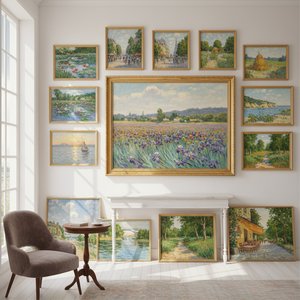
Claude Monet, arguably the most iconic figure of the Impressionist movement, became a central force in redefining how we perceive color and light. His 1875 painting, *Camille Monet and a Child in the Artist’s Garden at Argenteuil*, exemplifies this shift. Rather than meticulously detailing every leaf and flower, Monet focused on capturing the overall impression of sunlight filtering through the garden foliage. As Dr. Charles Cramer notes in Smarthistory's analysis of Impressionism as optical realism, Monet famously advised fellow artists to “forget what objects you have before you.” This wasn’t a dismissal of subject matter, but rather an invitation to prioritize the *experience* of seeing – to record the shifting patterns of light and color as they impacted the eye. Monet's work, like The Church at Varengeville, isn’t about accurately depicting a church; it’s about conveying the atmosphere, the quality of the light on that particular day, the sensation of being present in that moment. This focus on optical realism – capturing what the eye actually sees rather than relying on preconceived notions – was revolutionary. He wasn't interested in recreating reality but in interpreting it through the lens of light and color.
Brushstrokes and Broken Color: The Techniques Defining Impressionism
The techniques employed by Monet and his contemporaries were as radical as their subject matter. Abandoning the smooth, blended brushwork favored by academic painters, they embraced visible brushstrokes – short, broken strokes of pure, unmixed color applied directly to the canvas. This wasn’t simply a stylistic choice; it was a deliberate attempt to capture the vibrancy and fleeting nature of light. By juxtaposing complementary colors, Impressionists created an effect of intense visual vibration, mimicking the way light interacts with our eyes. The Banks of the Seine, Lavacourt 02, for example, showcases this technique beautifully; the water shimmers with reflected light, achieved through a mosaic of blues, greens, and purples. This approach differed significantly from traditional painting methods where colors were blended to create smooth transitions and realistic tones. The Impressionists sought to recreate the sensation of light itself, rather than simply representing objects illuminated by it.
Everyday Life as Subject Matter: Capturing Modernity in Paris and Beyond
The shift away from historical and mythological subjects extended to a fascination with everyday life. Impressionist artists turned their attention to Parisian boulevards, bustling cafes, leisurely picnics, and the quiet moments of domesticity. This wasn’t merely a rejection of grand narratives; it was an embrace of modernity – a desire to capture the changing rhythms and experiences of contemporary society. Snow Effect with Setting Sun, for instance, transforms a simple winter landscape into a captivating study of light and atmosphere. The focus shifted from depicting important events or figures to capturing the beauty inherent in ordinary moments. This democratization of subject matter – elevating the everyday to artistic significance – was a key characteristic of the movement. Artists like Joseph Delattre, bridging the gap between Barbizon School realism and Impressionism, further explored this theme through their depictions of rural landscapes.
Impressionism's Enduring Influence: From Post-Impressionism to Contemporary Art
The initial reception to Impressionism was far from enthusiastic. Critics derided their work as unfinished sketches, lacking in detail and proper form. However, the artists persevered, organizing independent exhibitions that gradually gained public attention. By the late 19th century, Impressionism had begun to gain acceptance, paving the way for subsequent art movements like Post-Impressionism. Artists such as Van Gogh, Cézanne, and Gauguin built upon the foundations laid by Monet and his contemporaries, further exploring color, form, and subjective experience. The legacy of Impressionism extends far beyond these immediate successors; its influence can be seen in countless artists who followed, from the Fauves to Abstract Expressionists. The emphasis on light, color, and individual perception continues to resonate with contemporary artists today.
Collecting the Ephemeral: Bringing the Beauty of Impressionism into Your Home
The allure of Impressionism lies in its ability to capture fleeting moments – a sun-drenched garden, a shimmering riverbank, a quiet evening snowfall. Bringing these evocative scenes into your home allows you to experience that beauty firsthand. At WahooArt, we specialize in handmade oil paintings and museum-quality prints of Impressionist masterpieces. Each reproduction is meticulously crafted by skilled artists on 100% cotton canvas using professional oils, ensuring a lasting tribute to the original artwork. Whether you’re seeking a statement piece for your living room or a delicate print for your bedroom, we offer a range of sizes and customization options to suit your individual taste. Explore our collection today and discover the enduring magic of Impressionism – a revolution that continues to inspire and captivate audiences worldwide.