The Masked Soul of Contemporary China
Zeng Fanzhi stands as a singular, haunting figure within the vast landscape of Asian contemporary art, a painter whose brush captures the profound psychological tremors of a nation in transition. Born in 1964 in Wuhan, Hubei province, his early consciousness was deeply etched by the turbulent legacy of the Cultural Revolution. This period of intense ideological conflict and societal pressure instilled in him an enduring sensitivity to the complexities of human identity and the masks we wear to navigate existence. His formative years, spent under the shadow of Mao Zedong’s rule, provided a backdrop of profound uncertainty that would later manifest in his work as a relentless pursuit of visceral expression and an unflinching confrontation with existential anxiety.
Seeking to master the tools of visual language, Zeng pursued formal training at the Hubei Academy of Fine Arts. It was here that he began to synthesize traditional foundations with the emotive power of Western art history. He found deep resonance in the works of German Expressionists, such as Ernst Ludwig Kirchner and Emil Nolde, whose use of distorted forms and raw, emotive abstraction offered him a way to communicate inner turmoil and societal injustice. His early explorations were characterized by large-scale abstract paintings, yet his true creative metamorphosis was catalyzed by his relocation to Beijing in the early 1990s. This move into the burgeoning urban center of China’s contemporary art scene provided a stark, often superficial environment that served as the perfect crucible for his developing style.
The Tension of the Mask and the Flesh
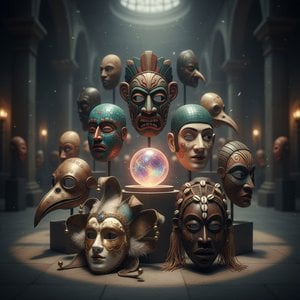
The arrival of Zeng Fanzhi's seminal Mask Series in 1996 marked a watershed moment in Chinese contemporary art. These portraits, featuring figures shrouded in white, featureless masks, became an instant icon of the era. Through these works, Zeng explored the profound tension between the artist's deep existential concerns and the performative, often pompous posturing of modern urban life. The masks serve as a powerful symbol of the social facades and the loss of authentic selfhood in a rapidly changing society. His technique in this series is masterfully calibrated; while his brushstrokes may appear expressionistic, they function with an ironic precision, playing against the superficially composed appearances of his subjects.
Beyond the masks, Zeng’s oeuvre delves into even more visceral territories, notably through his Hospital Triptych series. In these works, the artist explores themes of vulnerability, decay, and the raw reality of the human condition. His ability to render exposed flesh and awkward, oversized anatomical details creates an unsettling beauty that is both repulsive and deeply moving. This mastery of texture and color—often utilizing vibrant, bold tones reminiscent of his expressionist influences—allows him to bridge the gap between the physical body and the psychological state. Whether depicting the distorted features of a leader in his Mao paintings or the haunting stillness of bare trees in his untitled landscapes, Zeng’s work remains anchored in an intuitive psychological sense.
Legacy and Artistic Significance
Zeng Fanzhi's ascent to becoming one of China’s most financially successful and critically acclaimed artists is a testament to his ability to translate local historical trauma into a universal language of human emotion. His contribution to the Cynical Realism movement, while maintaining a highly individualistic voice, has helped define the trajectory of Chinese art on the global stage. His work does not merely document a period of change; it interrogates the very soul of that change, asking what remains of the individual when the structures of society are in constant flux.
Today, his paintings are held in prestigious collections worldwide, including the Ullens Center for Contemporary Art and the CAFA Art Museum. His enduring significance lies in his refusal to provide easy answers. Instead, through his use of oil on canvas and a uniquely calibrated expressionistic technique, he invites viewers into a space of profound contemplation, where the boundaries between the seen and the hidden, the public mask and the private soul, are perpetually blurred.