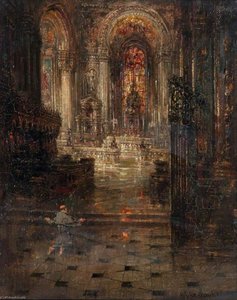
Sir Wyke Bayliss (1835-1906): A Victorian Vision of Sacred Space
Wyke Bayliss stands as a singular figure in Victorian art, an artist whose unwavering dedication to depicting the grandeur and intricacy of cathedral interiors cemented his reputation as both a meticulous craftsman and a respected academic voice. Born in Madeley, Shropshire, on October 21st, 1835, Bayliss’s unusual first name – derived from his mother’s surname – foreshadowed a lineage steeped in artistic heritage; his brother William Wyke Bayliss became a vicar, whilst sister Elizabeth Anne Bayliss married a vicar, and a second sister Mary tragically perished as a teenager. His family's connections extended to luminaries like Thomas Turner, founder of the Caughley Porcelain Factory, a pivotal innovator in willow pattern design – Bayliss possessed portraits by Sir Joshua Reynolds and numerous familial artworks by Lemuel Francis Abbott.
- Early Life & Family Influence: Bayliss’s father, Rev. John Cox Bayliss, was a railway engineer who instilled artistic sensibilities through drawing instruction, recognizing his son's aptitude at a young age. His diary, transcribed and published as “Wheels of Providence,” meticulously documented this formative period, offering invaluable insight into the boy’s upbringing and familial environment.
- Education & Artistic Formation: Bayliss pursued formal training at the Royal Academy and the School of Design, immersing himself in the burgeoning artistic landscape of London's early Victorian era. Notably, he befriended prominent Pre-Raphaelites like John Millais, Frederic Leighton, William Holman Hunt, and Edward Burne-Jones – though maintaining a stylistic distance from their expressive approach, his paintings often mirrored their characteristic blend of detail and color.
- The Pre-Raphaelite Connection & Artistic Style: While Bayliss didn’t fully embrace the Pre-Raphaelites' fervent romanticism or dramatic narratives, he undeniably absorbed their influence in terms of compositional technique and colour palettes. His meticulous observation of architectural forms and textures—particularly within churches—became his hallmark, prioritizing accuracy and tonal subtlety over flamboyant embellishment.
- Notable Works & Architectural Obsession: Bayliss’s artistic focus remained steadfastly on cathedral interiors. He produced celebrated depictions of Amiens Cathedral, St Peter's Church in Louvain, and numerous other ecclesiastical spaces across Europe. These paintings aren’t merely representations of buildings; they are meditations on faith, light, and the sublime beauty inherent in sacred architecture—works that continue to captivate viewers with their exquisite realism and evocative atmosphere.
- Legacy & Recognition: Bayliss served as President of the Royal Academy from 1897 until his death in April 1906, solidifying his position as a leading figure within Victorian artistic circles. His enduring contribution lies not only in his stunning visual achievements but also in his scholarly writings on art history and architectural design, shaping perceptions of aesthetic principles during his time.
Bayliss’s legacy resides in his unwavering commitment to capturing the spiritual essence of sacred spaces—a pursuit that elevated him beyond mere technical skill into a true visionary artist.