The Genesis of a Visionary
Willem Roelofs emerged from the artistic lineage of Amsterdam, born into a world where the brush and the pen were deeply entwined with family legacy. As the son of an esteemed member of the Painters’ and Draughtsmen's Society, his path toward the canvas was almost predestined. His early years in Utrecht, under the tutelage of Abraham Hendrik Winter, laid a foundation of technical rigor, but it was his subsequent move to The Hague that would truly ignite his creative spirit. Studying at the Academy for Visual Arts under Hendrik van de Sande Bakhuysen, Roelofs began to move away from the rigid structures of Romantic Classicism, seeking instead a more profound, atmospheric truth in the Dutch landscape.The Barbizon Spirit and the Hague School
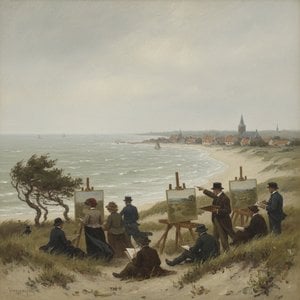
The true metamorphosis of Roelofs’s style occurred through his spiritual pilgrimage to the Fontainebleau region of France. During his visits in 1852 and 1855, he breathed in the essence of the Barbizon School, absorbing its devotion to unadorned nature and muted, evocative tones. This influence became the heartbeat of his work, characterized by heavy, brooding skies and the quiet, solemn beauty of rural life. Roelofs did not merely adopt this style; he became a conduit for it, transmitting these Impressionistic ideals back to the Netherlands and helping to forge the Hague School.His influence extended far beyond his own easel, as he acted as a mentor to a generation of masters who would define Dutch maritime and landscape art. Among those who studied under his guidance were:
- Hendrik Willem Mesdag, the legendary marine painter;
- Paul Gabriel, a fellow pioneer of the Hague School;
- Frans Smissaert and Willem de Famars Testas;
A Dual Legacy of Nature and Art
There existed within Roelofs a rare duality—a fascination with the vastness of the horizon and an equally intense devotion to the microscopic wonders of the earth. While his paintings captured the sweeping vistas of The Gein River or the tranquil paths near Laren, his scientific mind was often preoccupied with the intricate beauty of entomology. A dedicated specialist in beetles, Roelofs spent countless hours documenting the minute details of the natural world, publishing extensively in scientific journals and collaborating with the Natural History Museum in Leiden.This scientific precision likely informed the meticulous textures found within his landscapes, where every blade of grass and ripple of water was rendered with an observant eye. Whether he was peering through a lens at a specimen or standing before a wide meadow, Roelofs remained a true student of nature, leaving behind a legacy that bridged the gap between the poetic soul of an artist and the disciplined mind of a scientist.
Spørgsmål og svar
Hvor kommer Willem Roelofs fra?
Willem Roelofs blev født i Netherlands.
Hvor og hvornår er Willem Roelofs født?
Willem Roelofs blev født i Amsterdam i 1822.
Hvor kan man finde Willem Roelofss værker opdelt efter emne?
Willem Roelofss værker kan udforskes efter emne på kunstnerens Emneoversigt-side.